In-House vs Outsourced Automation: Which One a Lean Team Needs
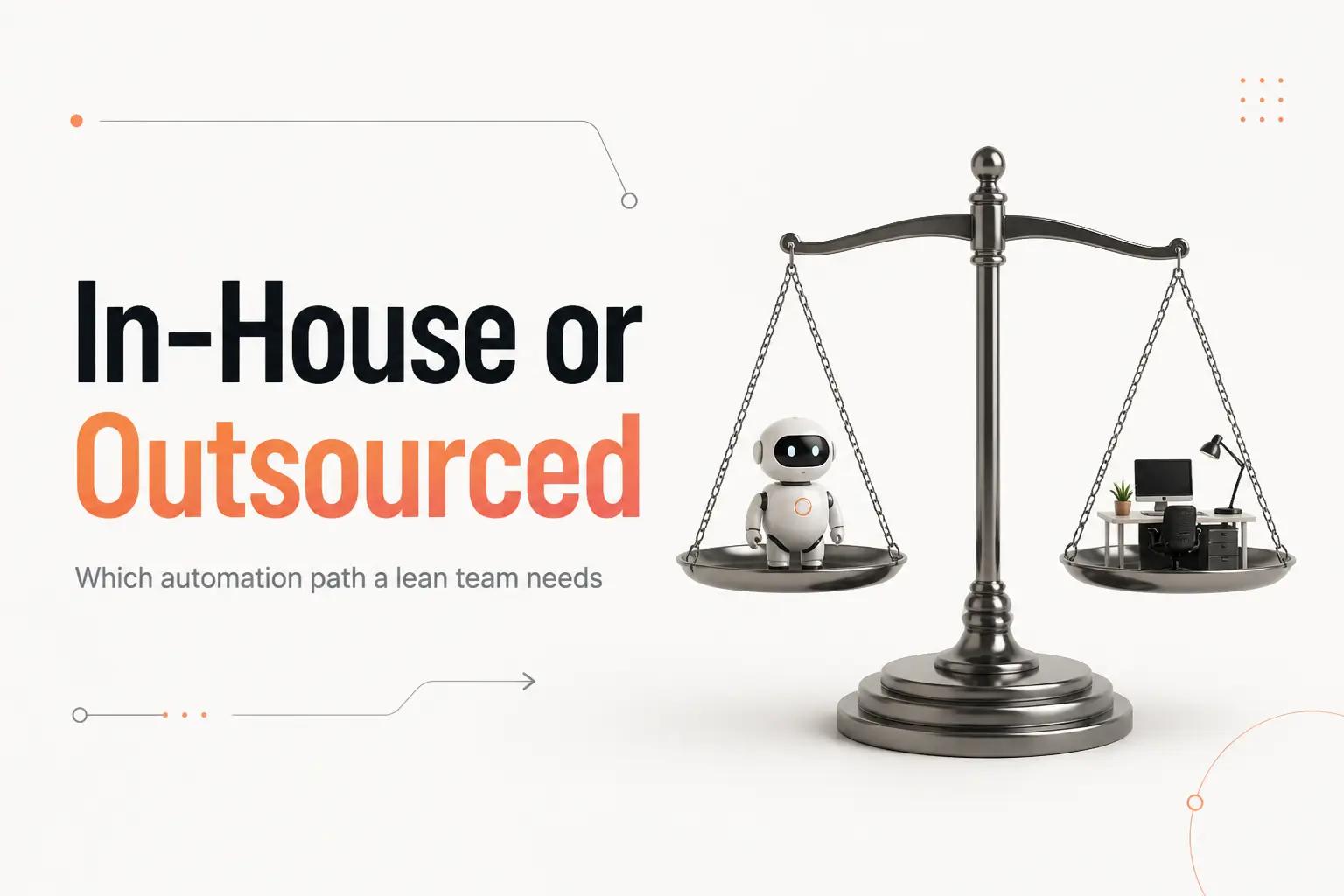
Automation finally made the roadmap. A dozen manual jobs are bleeding hours: leads re-keyed from a form into the CRM, Stripe charges reconciled by hand, the same weekly report rebuilt from three exports. Now the real question lands on the ops lead's desk. Do you post a job for an automation engineer to own all of it, or hand it to an outside team that builds it for you?
Most teams frame this as a budget decision and stop there. It is really a decision about how much automation work you have, how steady it is, and who owns the thing at 2am when a workflow silently stops firing. Get that wrong and you either pay six figures for someone who has three good weeks of work, or you rent a team forever for something you should have hired for.
So the comparison that follows is less about which is cheaper and more about which shape your automation work actually takes right now.
Quick verdict
For most teams under 50 people, outsourcing to a studio like bottta is the right first move, and it stays right longer than people expect. You get the work built and running in weeks instead of quarters, you pay a known number, and you do not carry a salary during the stretches when there is nothing to build. Our $4K project covers a fixed scope end to end, and the $3K/month retainer covers up to three active workflows with ongoing monitoring and fixes.
Hiring in-house wins in one specific case: automation is continuous, core to how the business runs, and there is enough of it to keep a full-time builder busy every week. If that is not clearly true yet, you are hiring ahead of the need.
In-house vs outsourced automation at a glance
| | In-house hire | Outsourced studio | |---|---|---| | What you pay | Salary plus benefits, taxes, tools, and management | Fixed project price or a monthly retainer | | Time to first workflow | Weeks to hire, then ramp on your stack | Days to start, weeks to ship | | Breadth of skills | One person's toolkit | A team across integrations, AI, and custom builds | | Who maintains it | The hire, until they are busy or gone | The studio, as part of the engagement | | Main risk | Idle time and single-person knowledge | Less deep context on your internal culture | | Best fit | Continuous, high-volume, core automation | Bursts of build work and steady upkeep |
The rest of this post is the reasoning behind that table, so you can pressure-test it against your own numbers rather than take the summary on faith.
What an in-house automation hire really costs
The salary is the number everyone quotes, and it is the smaller half of the truth. An automation engineer in the US averages $107,562 a year, and a senior one averages $133,596, per Indeed's salary data. That is base pay alone.
The real annual cost runs higher once you add employer payroll taxes, benefits, equipment, software seats, and the management time it takes to keep the role productive. None of that shows up in the job posting, and all of it lands whether or not there is a full week of automation work that month.
That last point is the one teams underestimate. A skilled builder can knock out a lead-to-CRM sync, a reconciliation job, and a reporting workflow in a few weeks. Then what? The reason to keep them on is a steady backlog: new integrations, new edge cases, monitoring, and fixes across a growing stack. If the backlog is thin, you are paying a builder to wait for work, which is the most expensive way to buy automation there is. We broke the full math down in build vs buy vs hire.
What outsourcing really costs, and buys
Outsourcing swaps a salary for a scoped price. A fixed-scope build is one known number. A retainer is a flat monthly fee for a running pool of work and the upkeep around it. You are not paying for idle time, because the studio absorbs the gaps between builds across its other clients.
What you actually buy is broader than a single hire. Automation work spans several skill sets that rarely live in one person:
- Workflow Design to map the process and design clean handoffs before anyone writes a line of glue.
- Integrations to wire the APIs and webhooks between tools that do not natively talk.
- AI Automation for the LLM layer: routing, extraction from PDFs and email, and drafting.
- Custom Builds when an off-the-shelf tool cannot do it and you need an internal tool, dashboard, or scheduled job.
A single engineer is strong in one or two of these and thin in the rest. A studio brings the whole set, plus the ongoing monitoring that keeps a workflow from failing quietly. The honest trade-off: an outside team knows your stack deeply but not your hallway conversations, so scope and priorities have to be communicated, not assumed. For a comparison of done-for-you options against the tools, see the best business automation services.
Where hiring in-house wins
Do not read this as a case against ever hiring. There is a real threshold where a full-time builder is the better call.
- The work never stops. Automation is core to how the product or operation runs, and there is a genuine backlog every week, not a burst followed by silence.
- Deep internal context matters. The workflows touch proprietary systems, sensitive data, or fast-changing internal logic that is easier to own from inside.
- You are large enough to spread the risk. A single automation hire is a single point of failure. When they take a week off or leave, undocumented workflows on one laptop become your problem. Bigger teams can absorb that. A 10-person shop usually cannot.
If those three are clearly true, hire, and hire someone who documents. If they are aspirational rather than current, you are staffing for a future that has not arrived.
Where outsourcing wins
For a 1-50 person operation, outsourcing wins on the things that actually hurt: speed, flexibility, and not carrying fixed cost through the quiet stretches.
- Speed to a working workflow. No job posting, no interview loop, no ramp. A studio starts on your backlog in days and ships in weeks.
- You pay for output, not attendance. A fixed price or a retainer maps to work delivered. There is no idle salary in a slow month.
- Coverage across the whole stack. The integration, the AI extraction, and the custom dashboard get built by people who each do that work daily, not by one generalist stretching to cover all of it.
- Someone owns the upkeep. Monitoring and fixes are part of the engagement, so a renamed field or a changed API is the studio's problem to catch, not a fire your ops lead discovers on a Monday.
The catch worth naming: you have to pick a studio that builds and maintains rather than one that sells a prompt and disappears. How to evaluate an automation agency is the pressure test for that.
How to decide
Match the path to your reality, not to a general rule.
- A handful of workflows, then mostly upkeep. Outsource. A fixed-price project turns the open-ended build into one number, and a retainer covers the maintenance without a hire. This is the common case for a lean team.
- A steady, growing backlog with deep internal context. Hire, once the backlog is real every week and you can document what gets built so it does not live in one head.
- One simple, stable, low-stakes automation. Neither. Build it yourself on a no-code tool and keep it small. Confirm it is even worth automating with our test for what to automate, and price the true cost with what automating one process actually costs.
- You are not sure yet. Start outsourced. It is reversible. You learn what your real automation load looks like from work that is already shipping, and you can hire later with actual data instead of a guess.
The pattern under all four: buy the burst, and only hire the steady state once you can prove it is steady.
Frequently asked questions
Is outsourcing automation cheaper than hiring?
For most teams under 50 people, yes, because you avoid paying a salary through the weeks with no build work. An automation engineer averages $107,562 a year in base pay alone, per Indeed, before benefits and management. A fixed project or a retainer only costs you when there is work to do. Hiring gets cheaper per workflow only once the backlog is large and constant.
Can I outsource now and hire later?
That is usually the smart order. Outsourcing ships workflows fast and shows you how much automation work you actually generate month to month. Once that load is clearly enough to keep a full-time builder busy, you hire with real data. Nothing you outsource blocks a later hire, as long as the studio documents what it builds.
What if an outside team does not understand our tools?
A studio that builds automations works across CRMs, Stripe, Slack, Sheets, Airtable, and the usual stack every day, so the tools are rarely the gap. The gap is internal context and priorities, which you close by mapping the process together up front. That mapping is the first thing Workflow Design does before any building starts.
Do we still need someone in-house to manage the automations?
Not to build or maintain them under a retainer, since monitoring and fixes are part of the engagement. You do want one internal owner who knows what each workflow is supposed to do and can flag when a process changes. That is an hour of attention, not a full-time role.
The call for your team
In-house versus outsourced is not really a cost question. It is a question of whether your automation work is a steady job or a series of bursts with upkeep in between. Steady, high-volume, core work justifies a hire. Bursts and maintenance, which is where most lean teams actually live, are cheaper and faster to outsource.
Most lean teams sit in the second camp and staff for the first. Before you write the job description, hand the backlog to a team that ships it now. Start a project or book a call at bottta.com, and we will map it, build it, and keep it running.