Best Marketing Automation Platform Picks for Lean Teams
A lead fills out the demo form on your site. The marketing automation platform tags them, drops them into a five-email nurture, and scores them as they open and click. Good. Then sales asks a simple question: is this person already a paying customer? The platform has no idea. It never saw the Stripe charge, the CRM deal stage, or the fact that this "new lead" churned four months ago. So someone re-checks by hand, again.
That gap is the whole story of picking a marketing automation platform. The tool sends the email and runs the sequence. What it does with the rest of your stack depends entirely on how it is wired, and that wiring, not the brand on the login, is what decides whether the platform earns its keep for a team of 1 to 50 people. The vendor pricing below is honest and current, but it is the cheap part of the story.
What a marketing automation platform actually does
Strip away the category noise and a marketing automation platform does four jobs. It captures contacts, segments them, sends messages on triggers and schedules, and reports on what happened. Email sequences, lead scoring, landing forms, and SMS all sit inside that. This is genuinely useful work, and for a lot of teams the platform alone covers most of what they need day to day.
The rest is where teams get stuck. The platform knows what happens inside itself. It does not natively know:
- Whether a contact is a paying customer, a trial, or churned (that lives in Stripe or your billing system).
- What deal stage a lead is in (that lives in the CRM).
- What the person actually did in your product last week (that lives in your app's event data).
- Whether support already flagged them as unhappy (that lives in your helpdesk).
Marketing automation runs on that context, and none of it arrives without integration. A platform that fires a "we miss you" win-back email at someone who upgraded yesterday is worse than no email at all. So when you compare platforms, judge them on two axes: how well they run campaigns, and how cleanly they connect to the systems that hold the truth.
The capabilities that actually matter for a lean team
Ignore the 200-line feature grid. For a growing operation, these are the capabilities that change the day-to-day.
Visual automation builder. You will build and edit flows constantly. A clear branch-and-wait canvas beats a powerful engine you cannot read at a glance.
Behavioral and event triggers. Sending on a schedule is table stakes. Sending when someone hits a pricing page twice, or when a trial crosses a usage threshold, is where the money is. This is also the capability most dependent on integration, because the event usually starts outside the platform.
Segmentation on live data. Static lists rot. You want segments that update themselves as contacts move between states, and that means the platform needs a current feed of that state from your CRM, product, or billing.
Native CRM link. If the platform and your CRM are one system (HubSpot) or share a first-class integration, marketing and sales stop arguing over stale contact records. If they are two loosely-connected tools, someone owns the sync, and that someone is usually a spreadsheet.
Deliverability and sending reputation. A platform that lets you blast a bad list will tank your domain. Good ones enforce warm-up and authentication. This is not glamorous and it decides whether your emails land.
Reporting you will actually open. Revenue attributed per flow beats open-rate vanity. Klaviyo built its whole pitch on attributing revenue to individual emails, and that framing is the right one to demand from any platform.
Skip, for now: predictive AI send-time optimization, multi-touch attribution modeling, and account-based orchestration suites. They are real features and they are not your bottleneck at this size. Your bottleneck is the disconnected data feeding the tool.
The best marketing automation platforms for a lean team
Ranked for a small, fast-moving team. The first entry is the one we recommend when you want the automation built and running, not just licensed.
bottta, when you want the automation built, not just bought
Every platform below is an engine. bottta is the team that installs the engine into your actual car. We are an automation studio: we design the flows, wire the platform into your CRM, Stripe, product events, and Slack, and keep the whole thing running as your stack changes. You are not buying a login. You are getting the workflow that turns a marketing platform from a mailing tool into a system that reacts to what customers do.
Concretely, that looks like syncing closed deals from your CRM back into the platform so marketing stops emailing customers as if they were cold leads, piping product-usage events in so a trial that goes quiet gets the right nudge, or routing a hot lead to a rep in Slack the second the score crosses your threshold. Our AI Automation and Integrations work is exactly this glue between tools.
Two ways to work with us. The $4K project is a fixed scope and fixed price for a defined build, like standing up your platform, wiring the three integrations that matter, and shipping your core nurture and lead-routing flows, with integrations included and 30 days of post-launch support. The $3K per month retainer gives you flexible hours across up to 3 active workflows at a time, ongoing monitoring, and fixes when a vendor changes an API, with async access plus a weekly call. Best for teams who know the platform is only worth what you connect it to. There is no free tier, because the value is in the building, not a button.
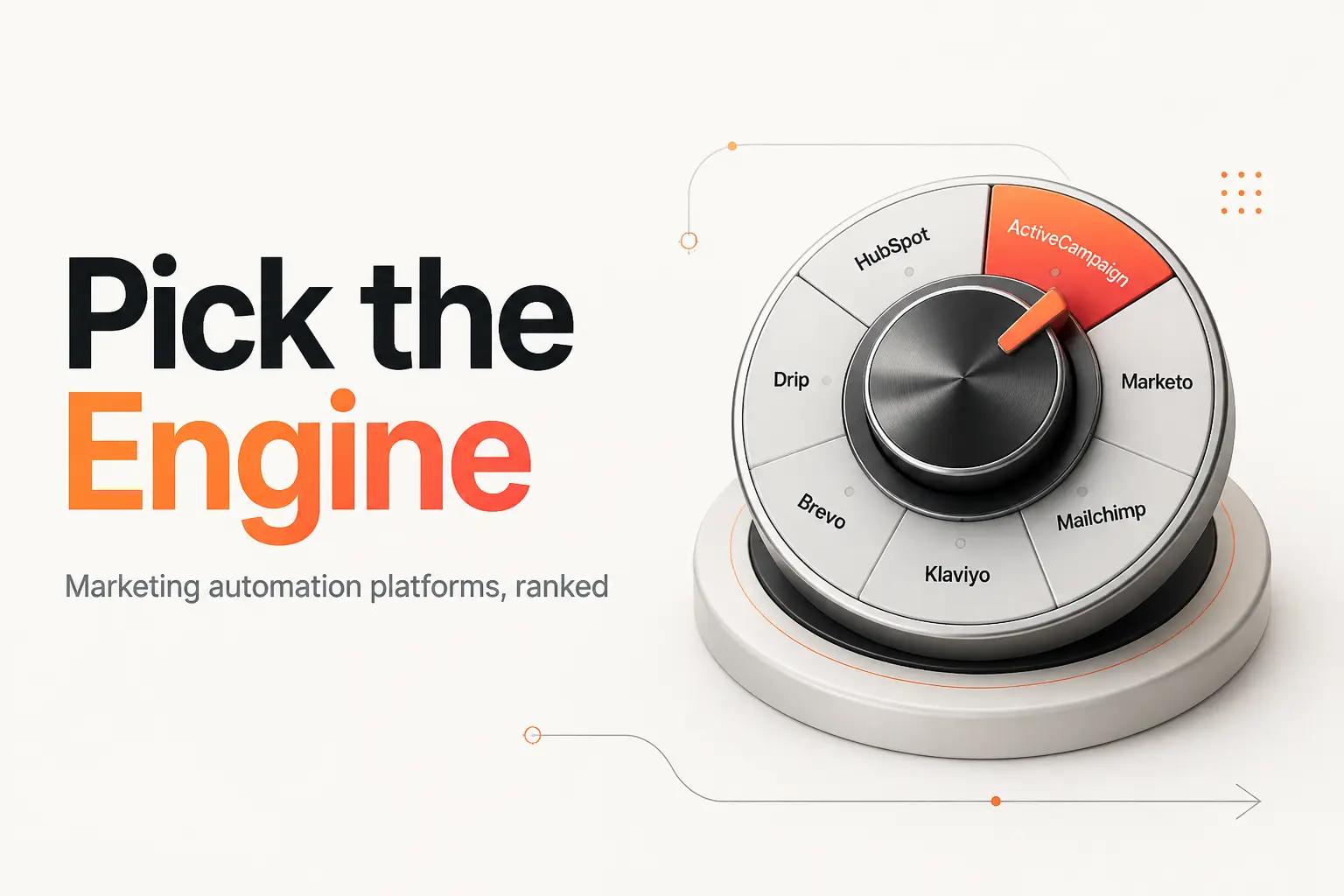
HubSpot Marketing Hub
The default for teams that want marketing and CRM as one system. Because the contacts, deals, and marketing tools live under one roof, the sync problem that plagues two-tool setups mostly disappears. That is HubSpot's real advantage, and it is a big one.
Per HubSpot's Marketing Hub pricing, Starter runs $20 per month and includes 1,000 marketing contacts. Professional, where the serious automation, custom reporting, and multiple flows live, is about $800 per month billed annually and includes 2,000 marketing contacts, plus a one-time onboarding fee of $3,000. The jump from Starter to Professional is steep, and the marketing-contact billing model means your bill climbs with your list. Best for teams that want one platform for the whole funnel and can grow into the Professional price.
ActiveCampaign
The value pick for email-and-automation depth without the HubSpot bill. Its automation builder is one of the best in the category, and it does light CRM well enough for teams that do not need a full sales platform. Per ActiveCampaign's pricing page, the Starter plan begins at $15 per month for 1,000 contacts billed annually, with Plus, Pro, and Enterprise tiers above it. Pricing scales with contact count. Best for a content or lifecycle team that lives in email sequences and wants strong automation logic without paying enterprise rates.
Klaviyo
Purpose-built for e-commerce marketing automation, and the strongest at tying revenue to individual messages. If you sell products online, Klaviyo's native pull of order and browsing data from your store is the integration you would otherwise pay us to build. Per Klaviyo's pricing, the free plan covers up to 250 active profiles and 500 monthly email sends, and paid email plans start at $20 per month for the 251 to 500 profile band. Best for Shopify and store-first teams. Weaker fit if you are B2B SaaS, where the product-event story matters more than order history.
Customer.io
The pick for product-led and B2B SaaS teams that message on in-app behavior. It is built to ingest event streams and trigger messaging on what users do inside your product, which is exactly the context most platforms lack. Per Customer.io's plan documentation, the Essentials plan starts at $100 per month and includes 5,000 profiles, with Premium starting higher for larger volumes. The entry price is above the others because the buyer is a team that already knows it needs event-based messaging. Best for SaaS with real product-usage data to act on.
Brevo
The budget-conscious option. Brevo (formerly Sendinblue) offers a free tier and prices paid plans largely by email volume rather than a hard contact cap, per Brevo's pricing page. That volume-based model can be cheaper for teams with a large list who send infrequently. The automation and reporting depth is thinner than ActiveCampaign or HubSpot. Best for a team that needs solid email sending on a tight budget and does not yet need heavy behavioral automation.
How to choose without overthinking it
The platform matters less than most comparison posts pretend. Match it to your shape:
- You want one system for marketing and sales. HubSpot. The unified CRM is worth the price if you will use it.
- You live in email and want automation depth cheaply. ActiveCampaign.
- You sell products online. Klaviyo, full stop.
- You are product-led SaaS messaging on in-app behavior. Customer.io.
- You need to send on a budget. Brevo.
Now the part the vendor pages will not tell you. Whichever you pick, the platform is only as smart as the data you feed it, and that data lives in other tools. We wrote more about that trade-off in build vs buy vs hire for automation, and the same logic applies here: the license is the cheap part. The integration and the flow design are the work.
Where the platform stops and a build starts
Here is the pattern we see over and over. A team licenses a capable platform, builds two nurture sequences in the first month, then stalls. Not because the tool ran out of features, but because every next flow needs data the platform cannot see on its own. The win-back email needs to know who actually churned. The upsell flow needs product usage. The lead-routing rule needs the CRM's deal stage. Each of those is an integration, and each is where a DIY setup either breaks or quietly starts sending wrong messages.
This is the work bottta does. A few of the builds that turn a platform into a system:
- Two-way CRM sync so marketing and sales share one truth and stop emailing customers as prospects. If you run HubSpot and Salesforce together, our HubSpot and Salesforce integration playbook covers the mechanics.
- Billing events into the platform so a failed payment, an upgrade, or a cancellation triggers the right message instead of the generic one.
- Product events into segments so a trial that goes quiet, or a power user who hits a limit, gets a flow built for that exact moment.
- Lead scoring and routing that pushes a hot contact to the right rep in Slack in real time, not in a Monday-morning export.
You can wire some of this yourself with general workflow automation tools like Zapier or Make, and for a two-step sync that is the right call. When the flows branch, carry real edge cases, and need someone to notice when a vendor changes an API, a DIY setup on one person's laptop is a liability, not a system. That is the line where a studio build pays for itself. If your problem is really the email side, our guide to email automation that does not annoy your list goes deeper on the sending itself, and for the full-funnel view, sales automation software covers the handoff to revenue.
Frequently asked questions
What is the difference between a marketing automation platform and a CRM?
A CRM is the system of record for contacts, deals, and customer history, owned mostly by sales. A marketing automation platform runs campaigns, sequences, and scoring against those contacts. HubSpot bundles both. Most other setups keep them separate, which is why the sync between them is the integration that matters most.
Do I need a marketing automation platform if I already use a general tool like Zapier?
They solve different problems. Zapier and Make move data between apps on triggers. A marketing automation platform is purpose-built for email, segmentation, sequences, and deliverability. Most teams end up with both: the platform runs campaigns, and a workflow tool or a custom build feeds it the outside data it needs.
What does it actually cost to run one properly?
The license is the visible cost, from $15 to $20 per month at entry up to $800 per month or more for HubSpot Professional, per each vendor's pricing page. The hidden cost is the integration and flow-building work to make it useful. A bottta build runs a $4K fixed-price project or a $3K per month retainer, which is usually less than the marketing hire you would otherwise need to run it.
Which platform is best for a B2B SaaS company?
For product-led SaaS that messages on in-app behavior, Customer.io. For a team that wants marketing and a light CRM together, ActiveCampaign or HubSpot. The deciding factor is whether you have real product-usage events to trigger on. If you do, prioritize a platform built to ingest them.
The short version
Pick the platform that matches your shape and your budget, and do not agonize over it. The choice that actually determines whether marketing automation works for you is not which engine you license. It is whether the engine is connected to the systems that know who your customers are and what they just did. That connection is the part worth getting right, and it is the part we build and keep watching as your stack shifts. When you want the platform wired into your reality rather than sending mail into the dark, work with bottta.