AI Strategy Consulting: What It Costs and What You Get
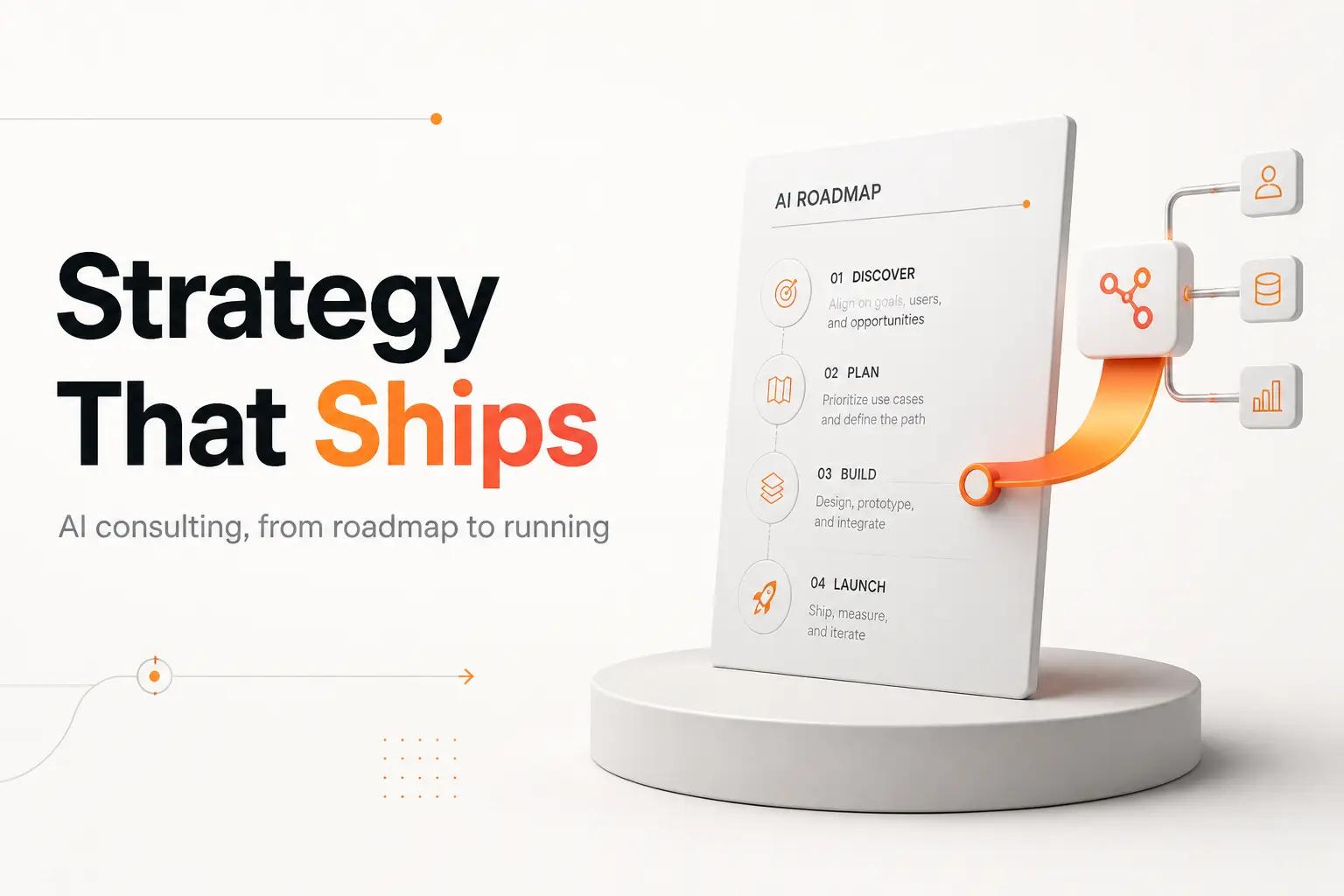
The deliverable arrives as a slide deck. Thirty pages, a heat map of "AI opportunities" scored on impact and feasibility, a phased roadmap, a maturity assessment, and a recommendation to "establish an AI center of excellence." It cost a good chunk of the quarter's budget and six weeks of your team's calendar answering discovery questions. It is genuinely thoughtful. And nothing in it runs. You now own a plan and still have to go find someone to build it.
That is the shape of most AI strategy consulting, and for a team of 1 to 50 people it is usually the wrong shape. The prioritizing, the sequencing, the build-versus-buy call are all real work worth paying for. The problem is buying them as a standalone artifact, disconnected from the people who would actually wire the workflow into your CRM. A separate strategy phase earns its price in a narrow set of cases, and most lean teams are not in them.
What AI strategy consulting actually buys you
Strip away the language and an AI strategy engagement produces a document and a set of decisions. A typical one covers four things.
- An opportunity assessment. Someone interviews your team, maps where AI could plausibly help, and scores each idea on business impact against effort. You end up with a ranked list of candidate use cases.
- A build-versus-buy call. For each candidate, a recommendation on whether to use an off-the-shelf tool, buy from a specialist vendor, or build custom, and roughly what each path costs.
- A roadmap. A phased sequence, usually drawn as quarters, of what to tackle first and what depends on what.
- Governance and readiness notes. Data-quality gaps, risk and compliance flags, and a maturity assessment against some framework.
All four are useful inputs. None of them is a workflow. The gap between "here is a prioritized roadmap" and "the closed deal now syncs to Stripe and posts the invoice link to Slack without anyone touching it" is the entire build, and pure strategy consulting hands that gap back to you.
For a lean team the honest question is not whether the strategy is good. It is whether you needed a separate, paid, weeks-long phase to produce it, or whether the prioritizing should have happened inside the same engagement that builds the first workflow. We argued the case for merging the two in AI consulting services for a lean team.
What AI strategy consulting costs
Pricing spreads enormously by who you hire, and most of the public numbers floating around come from consulting-marketing blogs rather than a source you can verify, so treat any precise figure you see with suspicion. What holds up is the shape of the market.
The big strategy firms sell AI strategy tied to operating-model change. McKinsey's QuantumBlack, BCG X, Bain, and the Big Four practices staff these with partners and senior consultants, price on partner-led time, and scope engagements at the enterprise, not the workflow. For a mid-sized company a serious AI strategy program from one of these firms runs into six figures before anything is built, and a full transformation into seven. They are excellent at board-level AI strategy for a Fortune 500 rewiring its operating model. That is not a lean team automating a lead handoff.
Boutique and independent AI consultants sell fixed-scope strategy work, often a roadmap or an opportunity assessment for a flat project fee, plus hourly advisory. This is a real step down in cost from the big firms and closer to a lean team's reality, but the deliverable is still frequently a document you then take elsewhere to build.
An automation studio like bottta folds the strategy into the build and prices it flat. There is no separate strategy invoice. The $4K project is fixed scope and fixed price for a defined workflow, integrations included, with 30 days of post-launch support. The $3K/month retainer keeps up to three active workflows running and monitored, with flexible hours and a weekly call. The prioritizing happens in the first conversation and the output is a workflow in production, not a deck.
| What you hire | What you get | Price shape | |---|---|---| | Big strategy firm (MBB, Big Four) | Board-level roadmap, operating-model change, governance | Six to seven figures, partner-led hourly | | Boutique / independent consultant | Fixed-scope roadmap or opportunity assessment | Flat project fee, plus hourly advisory | | bottta (automation studio) | Prioritizing plus the running workflow, in one engagement | Flat $4K project or $3K/month |
The table sorts by cost, not by fit. For most lean teams the fit runs in the opposite direction.
Why the strategy so often outlives the results
The reason to be skeptical of strategy sold on its own is not that the thinking is bad. It is that the plan is where AI spend goes to die, and the failure data is stark. MIT's NANDA initiative studied enterprise AI adoption and found that 95% of generative AI pilots produced no measurable P&L impact, based on 52 executive interviews, a survey of 153 leaders, and analysis of 300 public deployments. Gartner separately predicted that at least 30% of generative AI projects would be abandoned after proof of concept by the end of 2025, citing poor data quality, weak risk controls, rising costs, and unclear business value.
Read those two findings next to each other and the lesson is not "AI does not work." It is that the distance between a slide that impressed the room and a workflow that runs every day without babysitting is where the money evaporates. A strategy phase, delivered as its own artifact, sits entirely on the wrong side of that gap.
The same MIT research points at what closes it. Buying AI capability from specialized vendors and building partnerships reached successful deployment far more often than internal, from-scratch builds. That is the practical case against handing your team a roadmap and wishing it luck. The teams getting measurable returns embedded AI into end-to-end workflows with real integration and monitoring, which is engineering, not advice.
Strategy only, or strategy that ends in a running workflow
Here is the stance. For a 1 to 50 person team, buying AI strategy as a standalone deliverable is worth it in exactly one situation: the build genuinely cannot start until an organization-wide decision is made, and the decision is above the workflow. Restructuring how three departments share data, a data-residency call that changes your whole architecture, a compliance regime you must design around before a single integration goes live. That is real strategy, and it is worth a real engagement.
Everything short of that is better bought as strategy welded to the build. The prioritizing a lean team needs is not a 30-page maturity model. It is three questions asked honestly about each candidate workflow:
- How often does this task actually run? A weekly report is not worth the same investment as a hundred lead handoffs a day.
- What does one mistake cost? A misrouted internal note is cheap. A dropped invoice or a lead that never reaches sales is not.
- How stable are the inputs? A clean webhook payload is easy. A PDF that three vendors format three different ways needs an AI extraction step and error handling around it.
You do not need a six-week engagement to answer those. You need someone who has built the workflow before to score your list in a call and start on the highest-payoff one. We wrote up that scoring method in when to automate a task and when not to, and how to pick the very first workflow in first processes to automate.
A worked example: what a lean team actually needs
Say you run a 15-person agency. Inbound leads arrive through a website form, three referral partners email them in different formats, and someone re-keys all of it into HubSpot by hand every morning. Deals that close then need a Stripe invoice and a note in the finance channel. Today it is copy-paste, and twice this quarter a lead sat in an inbox for two days before anyone saw it.
A pure strategy engagement would score this, put "lead intake automation" in Q1 of a roadmap, note the HubSpot and Stripe dependencies, and hand you the plan. You would still need to find a builder, brief them again, and hope the estimate holds.
The build-first version skips the middle. The prioritizing takes one conversation: lead intake runs constantly, a missed lead is expensive, and the referral emails are messy enough to need an AI extraction step rather than the brittle rule a plain automation would use. So that workflow goes first. bottta builds the intake automation, uses a language model to pull the right fields out of the varied referral emails and drop them into HubSpot, wires the closed-deal to Stripe and Slack path on real integrations, and hands it over with monitoring so a silent failure surfaces before a customer notices. The invoicing workflow, lower volume, comes next under the retainer. The strategy was not skipped. It just did not get its own invoice or its own six weeks.
Where working with bottta changes the math
bottta is an automation studio, remote and global, that designs and builds the workflows, integrations, AI automation, and internal tools so your team stops doing the busywork by hand. The reason to start here rather than with a strategy firm is that the two halves you are trying to buy, the recommendation and the running workflow, come from the same team in one engagement, priced flat.
That matters because the failure numbers above are almost entirely a failure of the second half. Getting a smart plan is not the hard part in 2026. Getting a workflow that survives messy inputs, model changes, and its own bad days is. Our AI Automation work treats the model as one judgment step inside a workflow engineered to keep running, sitting on top of real integrations between your CRM, Stripe, Slack, and sheets. You see the price before any call, you own the credentials and the workflow, and the deliverable is something in production.
If your list of AI ideas is genuinely enterprise-wide and above any single workflow, a big strategy firm's price and process are the right tool, and you should not talk yourself out of it. For most lean teams, the better first move is the one that ends in something running. Compare the paths in more detail in the AI automation agency guide and in-house vs outsourced automation. The prioritizing you actually need takes one honest conversation about the workflow eating your mornings, not a six-week engagement and a deck.
Book a call or start a project at bottta.
Frequently asked questions
What is the difference between AI strategy consulting and AI implementation? Strategy consulting produces decisions and a plan: which use cases to prioritize, build versus buy, sequencing, and governance. Implementation is the actual engineering that turns one of those decisions into a workflow running in production. Pure strategy firms often deliver the first and leave you to source the second. A studio like bottta does both in one engagement, so the output is a running workflow rather than a document.
How much does AI strategy consulting cost? It spans a huge range. Big strategy firms scope AI work at the enterprise level and run into six and seven figures on partner-led rates. Boutique and independent consultants sell fixed-scope roadmaps for a flat project fee plus hourly advisory. bottta folds the prioritizing into the build and charges flat, a $4K fixed-scope project or a $3K per month retainer, with the price visible before any call. Be wary of precise figures on consulting-marketing blogs, since most are not verifiable.
Do I need an AI strategy before I automate anything? Not a formal one. For a lean team the prioritizing that matters is three questions per workflow: how often the task runs, what a mistake costs, and how stable the inputs are. That can be answered in a conversation with someone who has built the workflow before. A separate weeks-long strategy phase is worth it only when a decision above the workflow, like a company-wide data or compliance change, genuinely has to be made first.
Why do so many AI projects never reach production? Because a plan and a demo both sit on the wrong side of the hard part. MIT found 95% of enterprise generative AI pilots delivered no measurable P&L impact, and Gartner expected at least 30% of projects to be abandoned after proof of concept, largely due to poor data quality, weak controls, and unclear value. The teams that succeed embed AI into end-to-end workflows with real integration and monitoring, which is engineering work, not advice.
Is a big consulting firm ever the right choice for a small business? Yes, when the scope is genuinely enterprise-wide and the decisions are above any single workflow, such as restructuring how departments share data or designing around a new compliance regime. For a lean team automating a lead handoff or invoice flow, a big firm is a mismatch on both cost and shape, and a build-first studio gets you to a running result faster and cheaper.