How to Automate Data Entry Without Corrupting Your Records
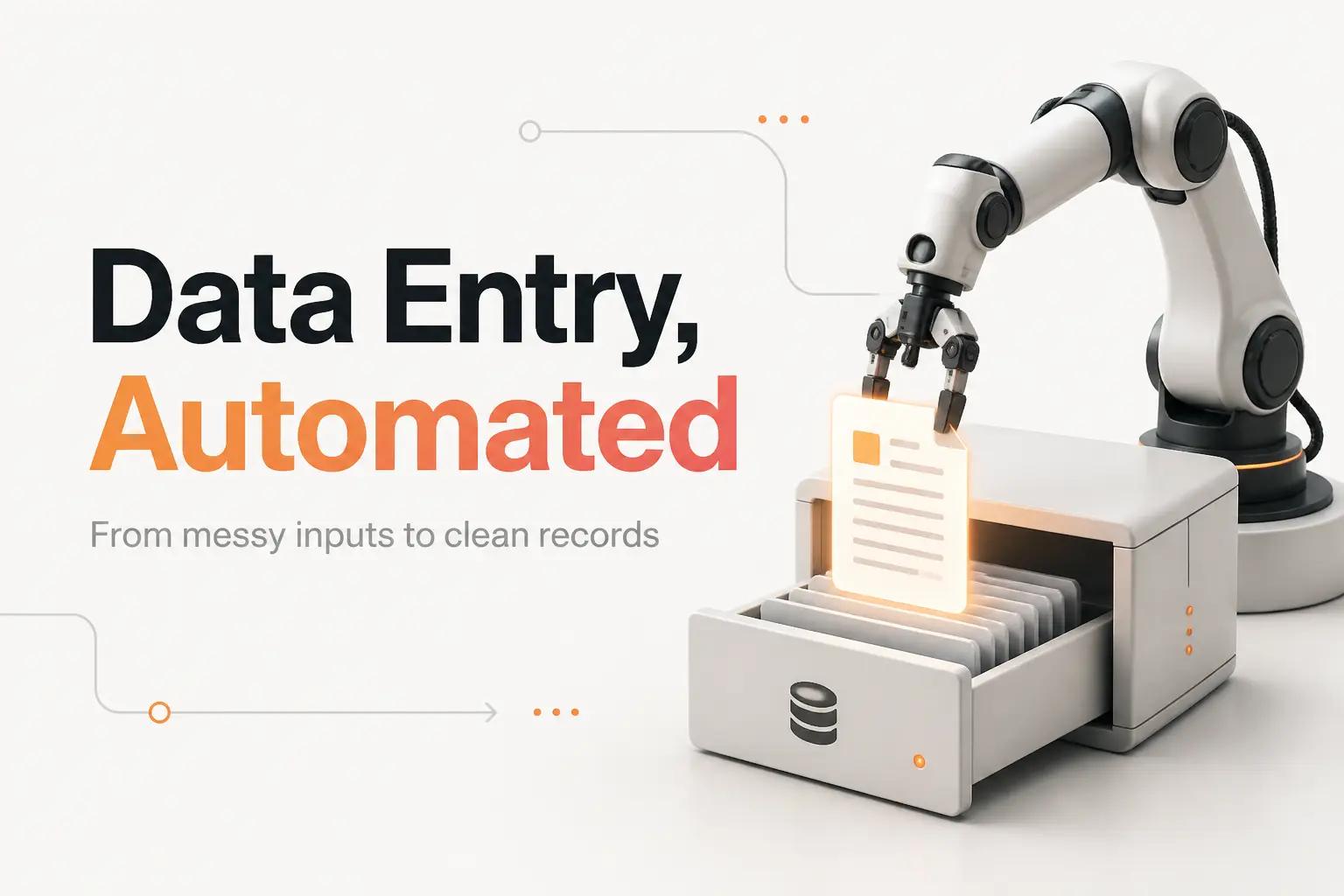
A web form fills up overnight. By 9am someone has it open on one monitor and your CRM on the other, tabbing between the two, retyping the same dozen fields a lead already typed once. Same motion at month-end, when a stack of supplier PDFs gets read and keyed into the ledger. Same motion when a CSV from one tool gets cleaned up and pasted into another.
This is data entry, and almost none of it needs a person. The catch is that "automate data entry" means several different jobs depending on where the data starts. A digital form is close to a solved problem. A scanned invoice is a different job. A free-text email asking to reschedule an order is a third one again. Sort the inputs wrong and you either pay for document OCR you never needed or hand a model a file it cannot read reliably, then wonder why 1 record in 12 is garbage.
Almost every team gets this wrong the same way. They grab one tool, point it at everything, and find out months later that a slice of their records are quietly corrupt because the tool that nails a CSV import chokes on a scanned invoice. The difference between an automation that ends the retyping and one that poisons your database is not the tool you buy, it is how you wire it. The tools and prices below are current as of August 2026.
First sort your inputs, because they are not one problem
Before you pick a tool, label the data by how structured it is when it arrives, and be honest about whether it is clean enough to automate at all. The right automation for each is different, and the most common expensive mistake is treating all three as one.
- Structured and digital. A web form, a Typeform, a CSV export, an API payload, a row someone adds in Airtable. The fields are already separated. There is nothing to "read" here. This is a mapping-and-moving problem, not a data-extraction one.
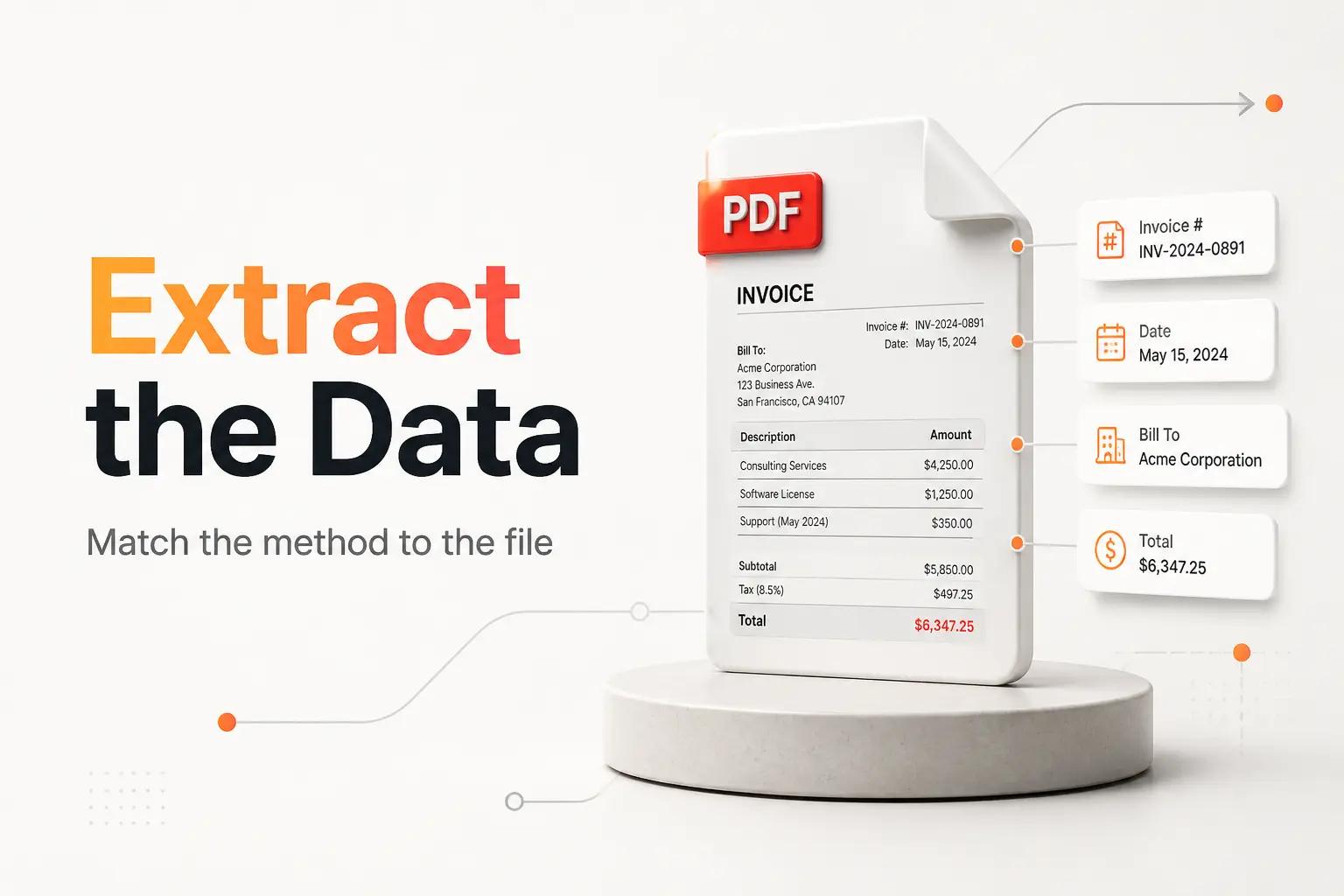
- Semi-structured documents. Invoices, receipts, purchase orders, shipping manifests. The same fields exist on every document but land in a different spot on each vendor's template. A human reads them fast. A machine needs OCR or a document model.
- Unstructured text. A customer email that says "push my Tuesday delivery to Thursday and add two more cases," a support message, a scanned handwritten note. No fields at all, just meaning you have to pull out.
Most teams have all three flowing at once and try to solve them with a single tool. That is why the CSV import works and the invoice capture flakes out. Match the method to the input shape, and each stream gets easy in isolation.
Start with the highest-volume, lowest-judgment stream
Do not automate the interesting document first. Automate the boring one that happens most and needs the least thinking, because that is where the hours are and where a machine is most trustworthy.
Score each candidate stream on three things: how often it runs, how repeatable the format is, and how fast a human could verify one record. A lead form that lands 60 times a day, always the same fields, checkable in two seconds, is the ideal first target. A batch of one-off contracts with unique terms is the worst, because a person has to read every one anyway.
For a document-heavy stream, the payoff is real once the format is consistent. A peer-reviewed study in The Engineering Economist measured automated invoice processing running roughly 81% faster than manual keying, about 5.7 minutes saved per invoice. That gain shows up when the input is structured and checkable, and evaporates when every document is a special case. Pick the stream that scores high on all three, ship it, then move to the next. One working automation beats five half-built ones nobody trusts.
Map the trigger and every system the data has to touch
Once you have picked a stream, map its path before you build anything. Every data-entry automation is really an answer to three questions: where does the data enter, where does the clean version have to land, and which system is the source of truth if two of them disagree.
Write it out concretely. A lead-to-CRM flow might read: form submission fires a webhook, the record has to land in HubSpot with the right owner assigned, and HubSpot wins over the spreadsheet copy if they ever drift. An AP flow reads: invoice arrives in a monitored inbox, coded data has to land in QuickBooks, and the ledger is the record of truth. Naming the source of truth up front kills the most common failure, where two tools each hold a slightly different version of the same customer and nobody knows which is right.
This mapping step is also where you decide what the machine is not allowed to do on its own. A new vendor, an amount over a threshold, a field it could not read cleanly - those are the cases that route to a human, and you cannot design that routing until you have drawn the path. We break down handoff design further in how to automate a lead-to-CRM handoff cleanly.
Choose the capture layer that matches the input
This is the decision that makes or breaks the cost. Each input shape from the first section maps to a different capture method, and the price gap between them is large. Here is what each costs, from vendor pricing pages.
| Input shape | Capture method | Representative price | Source |
|---|---|---|---|
| Structured, digital (forms, CSVs, app-to-app) | Field mapping over a workflow tool, no OCR | Zapier Starter $19.99/mo (750 tasks), Make Core ~$9/mo, n8n Starter $20/mo | Zapier, Make, n8n |
| Semi-structured documents (invoices, receipts) | Cloud OCR / form parser | Google Document AI OCR $1.50 per 1,000 pages, Form Parser $30 per 1,000 pages. AWS Textract text $1.50 per 1,000, Forms $50 per 1,000 | Google, AWS |
| Unstructured or messy, varied text | LLM extraction | Claude Haiku 4.5 $1 / $5 per million tokens. Sonnet 5 $2 / $10 through Aug 31, 2026 | Anthropic |
Read the table as a decision, not a menu. If your data is already digital and separated into fields, you do not need OCR or a model at all. A workflow tool maps the form field to the CRM field and writes it through the API. Reaching for a document model here is paying to solve a problem you do not have.
For semi-structured documents, a purpose-built form parser is usually the right first reach. Google Document AI's Form Parser at $30 per 1,000 pages pulls key-value pairs and tables from invoices and receipts without you training anything. It is cheap enough that even a few thousand documents a month costs less than an hour of the person currently keying them.
The LLM layer earns its place on the messy end, where the input varies too much for a fixed parser: a free-text email, a document whose format changes every quarter, a case where you need the model to reason about what a line means, not just where it sits. Claude Haiku 4.5 at $1 and $5 per million tokens is cheap enough that classifying and extracting from a month of inbound emails typically runs a few dollars. The trap is using it for a job a $1.50-per-1,000-page OCR call would do more reliably. Structured extraction beats open-ended "summarize this" prompts every time accuracy matters.
Where bottta fits in this layer
Here is the honest version of what these tools do and do not give you. Each one captures data. None of them is your workflow. Google Document AI returns fields. It does not decide what counts as low confidence, route the exceptions, write to your ledger, or tell you when it breaks. The workflow tools move data between apps but stall the moment a document needs reading. The model reads anything but has no idea what your system of truth is.
That connective layer is what we build at bottta. We are an automation studio, so the recommendation is not "buy this tool," it is "let us design the process and wire the pieces so the data lands clean without a person retyping it." Concretely, that is our Integrations work (the API glue from the capture tool into your CRM, ledger, or database) and our AI Automation work (the extraction model, the routing logic, the confidence gate). We pick OCR versus a model per stream based on what your documents actually look like, not on which vendor we like. The point is that you own one running system afterward, not three logins and a pile of half-connected credits.
Put a confidence gate between the machine and your records
This is the step that separates an automation you can trust from one that quietly poisons your database. No capture method is right 100% of the time. A form parser will misread a smudged total. A model will occasionally confidently invent a field. The question is never "is it perfect," it is "what happens to the record it got wrong."
The answer is a confidence threshold with human review on the exceptions. Every capture tool returns a confidence score per field. You set a line. Records above it, clean and unambiguous, flow straight through to the system of record. Records below it, plus anything hitting a business rule you flagged during mapping, route to a person to confirm before they land.
- A new entity you have never seen (a first-time vendor, an unknown company on a lead) goes to review, because there is no history to check it against.
- A value outside normal range (an invoice 10x your average, a quantity with an extra zero) goes to review, because those are the errors that cost real money.
- Any field the tool flags as low confidence goes to review, because the machine already told you it is unsure.
A parser that is right 97% of the time is a gift on the 97 and a liability on the 3, and only if nobody catches the 3. The gate is what catches them. It is also a design decision, not a setting you toggle. Deciding where the line sits for your data, and building the review queue a non-technical person can actually clear, is the part generic tools leave to you.
Write to the destination through the API, then confirm
Getting the data clean is only half the job. It still has to land in the right place, and a surprising number of DIY automations think they wrote a record when they silently did not.
Write through the destination's API, not by simulating clicks in the interface. An API write returns a result you can check: the record ID it created, or the error it threw. Screen-driven approaches that mimic a human typing into a browser break the instant the vendor moves a button, and they cannot tell success from failure. This is one of the sharpest lines between brittle screen-scraping RPA and a durable integration, and it is why we reach for the API every time one exists.
Then confirm the write. After pushing a record, read it back or check the API response, and only then mark the source item as done. A workflow that marks an invoice "processed" but never confirmed it hit the ledger is worse than manual entry, because now the error is invisible and the source is already archived. Verify, then close the loop.
Add monitoring so a silent failure never rots the database
The workflow that runs today is not the workflow that runs in six months. A vendor changes an invoice template, a form adds a field, an API token expires, and a process that was clean at 200 records a month behaves differently at 4,000. Without monitoring, the first sign of a broken data-entry automation is a customer record that has been wrong for weeks.
Three things need to be watching every stream:
- An exception-rate alert. When the share of records routed to human review jumps, something upstream changed. A vendor's new template or a form tweak shows up here first.
- A write-failure alert. When a push to the CRM or ledger fails, someone hears about it the same day, not at the next audit.
- A periodic spot check. A human eyeballs a small sample of auto-entered records against the source every so often, so drift that slips past the other two alarms still gets caught.
This is unglamorous and it is the whole difference between an automation that ends the manual grind and one that starts a quieter, worse problem. Whether a stream is even worth this overhead is a real question. If your input format changes constantly, the monitoring cost can outrun the hours saved, and we will tell you to leave that one manual.
Common mistakes that turn automation into cleanup
The same failure patterns show up whenever a team wires data entry without a plan.
- Using one tool for all three input shapes. The CSV import works, so you point the same tool at scanned invoices and it chokes. Sort the inputs first, then pick a method per shape.
- Paying for OCR on data that is already digital. Running a form parser over structured API payloads is money spent to solve a problem you did not have. If the fields are already separated, just map them.
- Skipping the confidence gate. A 97% accurate capture with no review on the exceptions means 3 in 100 records land wrong and unnoticed. In a customer database or a ledger, those compound.
- Faking clicks instead of using the API. Screen-driven entry breaks on the next interface change and cannot tell a success from a failure. Use the API wherever one exists.
- No owner and no monitoring. A setup one person built and nobody maintains rots the first time a format changes, and by then the bad data is already downstream.
When to DIY and when to bring in bottta
Here is the honest split. If you have one high-volume, structured, digital stream, a clean destination, and someone willing to own it, a no-code tool like Zapier or Make will map the fields and move the data, and for that job it is the right call. Start there. You do not need a studio to sync a form to a CRM.
You bring in bottta when the job crosses what those tools handle alone: documents that need reading, a confidence gate with a review queue, extraction that has to be right because it writes to your ledger or your customer database, and monitoring that catches a silent failure before it spreads. That is a design and integration problem, and it is what we do. Working with us takes one of two shapes.
- The $4K project is fixed scope and fixed price for one full data-entry workflow, integrations included, with 30 days of post-launch support. The right fit when you have a specific fire, like supplier invoices that never land in the ledger cleanly, and you want it built once and handed over.
- The $3K/month retainer keeps up to three active workflows built, monitored, and fixed as your formats and volume shift, with async access and a weekly call. The right fit when manual re-keying is a steady backlog across several streams and you have no engineer to own it.
The alternatives are hiring an in-house automation person, which rarely pencils out below a certain size, or building it yourself and accepting that you now maintain it. On a call we will tell you which of those is actually right, even when it is not us. The same build-versus-buy logic runs through everything in our guide to AI automation for small business.
Frequently asked questions
What is the best tool to automate data entry?
There is no single best tool, because "data entry" is three jobs. For structured digital data (forms, CSVs, app-to-app), a workflow tool like Zapier, Make, or n8n maps and moves it. For semi-structured documents (invoices, receipts), a form parser like Google Document AI reads it. For messy, varied text, an LLM like Claude Haiku extracts it. The skill is matching the method to the input and wiring the whole path, which is what an automation studio does for you.
How much does it cost to automate document data entry?
Less than most people expect at the capture layer. Google Document AI's Form Parser runs $30 per 1,000 pages and AWS Textract's Forms feature runs $50 per 1,000, per their pricing pages, so a few thousand documents a month costs less than an hour of manual keying. The larger cost is the build: the integration into your system of record, the confidence gate, and the monitoring. That is where a project or retainer with a studio like bottta pays off, because the tool cost was never the hard part.
Is OCR or an AI model better for reading documents?
Use a purpose-built OCR form parser for consistent, semi-structured documents like invoices and receipts. It is cheaper, more predictable, and returns confidence scores per field. Reach for an LLM when the format varies too much for a fixed parser or when you need the model to interpret meaning, not just locate a field. Many real workflows use both: OCR to pull the raw fields, a model to handle the exceptions and edge cases the parser flags.
Can I automate data entry without any coding?
For simple, structured handoffs, yes. A no-code tool can sync a form to a CRM with no code. The limits show up fast: read a PDF, apply confidence-based routing, write reliably through an API, and add monitoring, and you are past what drag-and-drop covers. That is the point where teams either learn to code it, hire someone, or bring in a studio to build and run it.
How do I stop automated data entry from creating errors?
Never let a capture tool write straight to your system of record without a confidence gate. Set a threshold, send low-confidence records and anything hitting a business rule (a new vendor, an out-of-range value) to human review, and let only clean records flow through. Add a spot check and a write-failure alert on top. The machine handles the volume, a person handles the cases it is unsure about, and neither one is retyping the easy 97%.
The tool was never the hard part
Automating data entry is not one purchase, it is a sequence of decisions: what shape your data arrives in, which capture method fits each shape, where the confidence line sits, and how you catch it when a format changes. Get those right and the retyping stops without your records paying for it. Get them wrong and you have automated your errors instead of your effort.
The stream eating your mornings has a shape. It is structured, semi-structured, or messy text, and that shape decides whether the fix is an afternoon on Zapier or a real build with a confidence gate. If you are not sure which one you are looking at, that is the first thing worth a conversation. Book a call with bottta and we will figure out the shape before anyone quotes you a price.