AI Automation for Small Business: A Complete Guide
A deal closes in HubSpot at 4pm on a Tuesday. Someone still has to open Stripe, create the invoice, copy the amount into a spreadsheet, and post the payment link in the finance channel. None of it is hard. All of it is a person doing the same six clicks, for the fourth time that day, and every so often fat-fingering an amount or forgetting the Slack post entirely.
That is the work "AI automation for small business" is supposed to remove. The phrase gets stretched to cover everything from a two-step Zapier rule to a chatbot that answers your customers, so it helps to be precise about what it means, what it is made of, and what each piece costs before you spend a dollar or an afternoon on it.
Here is the honest version most vendor pages skip. A lot of the busywork burning your team's hours is more automatable than it looks, and less of it actually needs AI than the marketing implies. Plain automation moves data between tools on a fixed rule. AI earns its place only where a step needs judgment: reading a messy PDF, classifying a support email, drafting a reply. Draw that line correctly and automation gets cheap and reliable. Blur it, and you end up paying for a model where a plain rule would have done, or trusting one with a step it quietly gets wrong.
What "AI automation" actually means for a small business
Strip the hype and there are two different things wearing one label.
The first is workflow automation: software that watches for an event and then does a fixed sequence of actions. A form submission lands, so a contact gets created in the CRM, a row gets added to a sheet, and a welcome email goes out. No intelligence, just wiring. This is the majority of what a growing team needs, and it has existed for years.
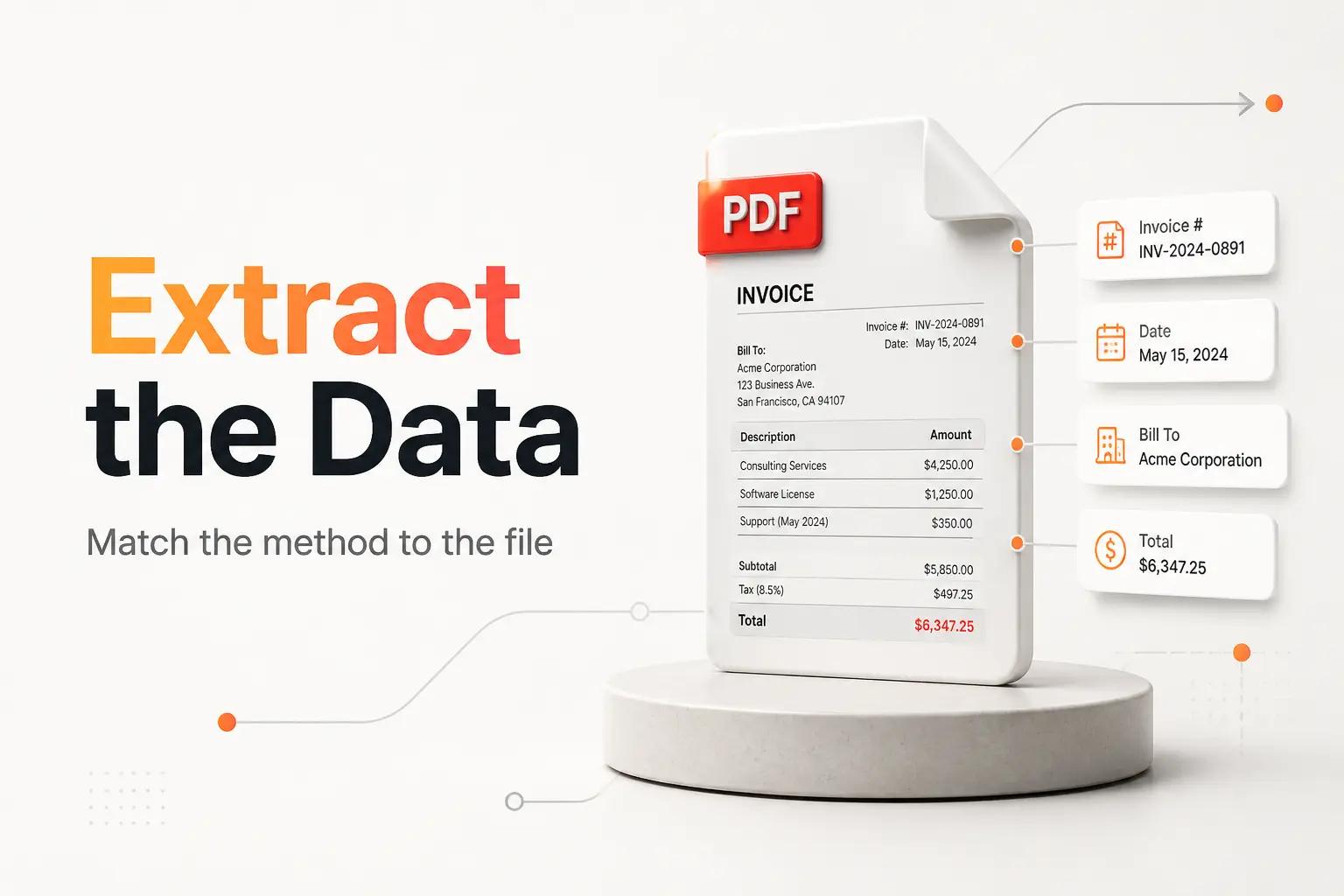
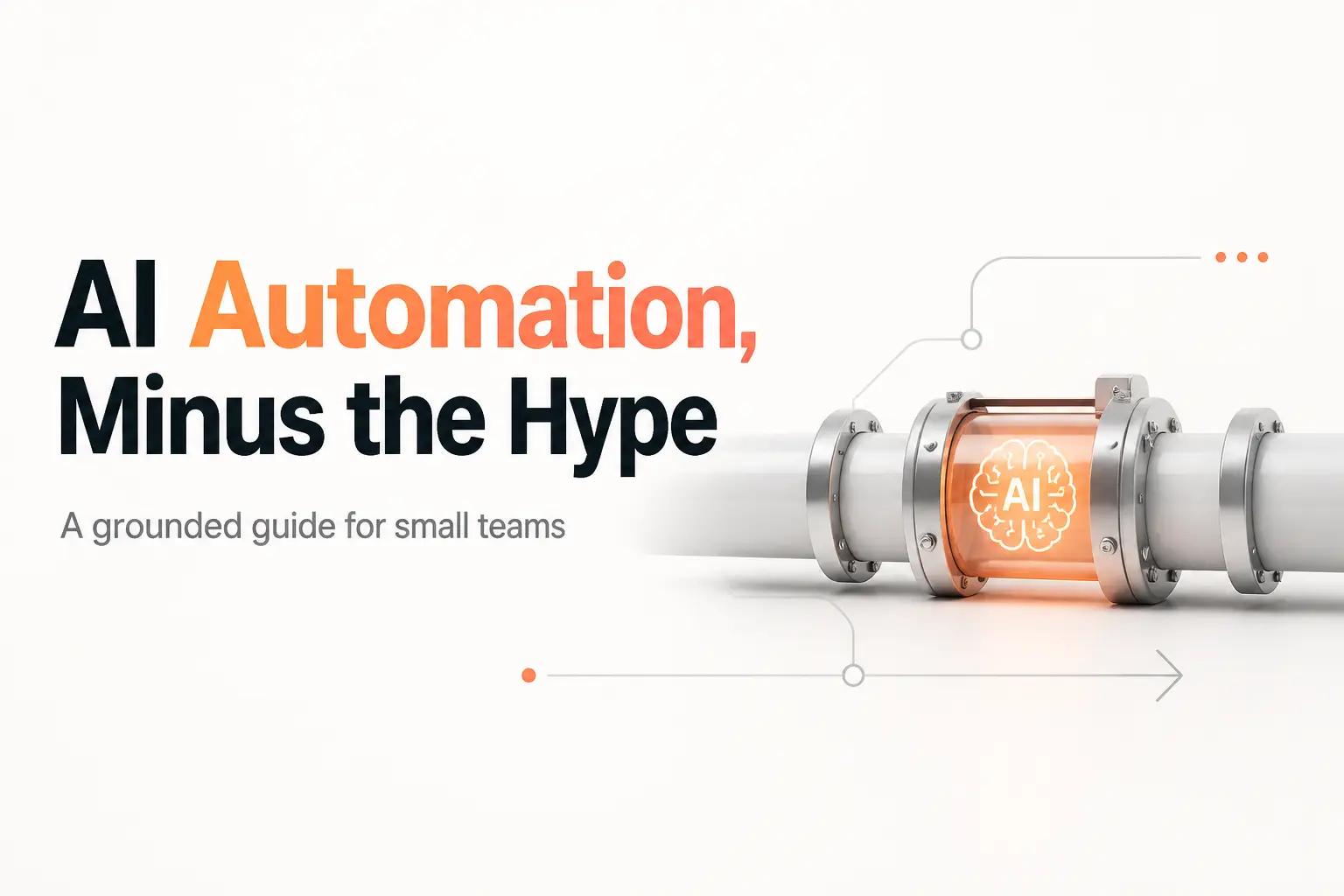
The second is AI automation: the same wiring, but with a step in the middle that makes a judgment a fixed rule cannot. An invoice PDF arrives, a language model reads it and pulls the vendor, amount, and due date, and only then does the fixed workflow file it. The AI is one component inside the pipe, not the whole pipe.
That distinction matters because it decides your cost and your risk. Fixed automation is cheap, predictable, and easy to trust. The AI step is where money and uncertainty enter, since a model can be wrong in ways a rule never is. The teams that get value out of this keep the AI confined to the one or two steps that genuinely need it and let plain automation carry everything else.
Rule of thumb: if you can write the step as "if this exact thing, always do that exact thing," it is not an AI problem. AI is for the steps where the input is messy and the right answer needs reading, not matching.
The three layers every AI automation is built from
Almost every useful automation, from a simple sync to an agent handling tickets, is the same three parts stacked together. Naming them makes the tool choices and the costs legible.
1. The trigger and the plumbing
Something has to kick the workflow off and carry data between your tools. A new row, a received email, a webhook from Stripe, a scheduled 6am run. Then the "glue" moves that data from one system to the next through APIs and webhooks. This is where most projects quietly break, not in the AI, but in the boring integration between two apps that were never designed to talk. A CSV export that mangles any customer name with a comma in it will sink a workflow faster than any model ever will.
2. The AI decision (only where needed)
If a step needs to read, classify, extract, or draft, a language model handles it. This layer is optional and should be small. You send the model some text, it returns structured output, and your workflow continues. The skill here is keeping the model on a short leash: a tight prompt, a defined output shape, and a confidence gate so anything the model is unsure about routes to a human instead of straight through.
3. The action and the monitoring
The workflow writes the result somewhere that matters: creates the invoice, updates the CRM, posts to Slack, files the record. Then, critically, it watches itself. An automation with no monitoring is a liability, because the failure mode is silent. It stops working on a Tuesday and you find out three weeks later when a customer asks where their invoice went.
Get these three layers clear and the rest of this guide is just choosing what fills each one.
Where a lean team should actually start
The instinct is to automate the flashiest thing. The better move is to automate the most frequent, most stable, lowest-judgment thing first, because that is where automation pays back fastest and breaks least.
Good first candidates share a shape. They happen often, they follow the same steps every time, and a mistake is annoying rather than catastrophic:
- Lead-to-CRM handoff. A form or ad lead lands and gets created, tagged, and assigned in the CRM without anyone re-typing it.
- Invoice and payment glue. A closed deal or new charge triggers the invoice, the finance-channel note, and the spreadsheet update.
- Data extraction from documents. Invoices, receipts, or order emails read by a model and dropped into the system as structured fields. This one genuinely needs the AI layer.
- Status and reminder chasing. The nudges and follow-ups a person currently sends by hand on a schedule.
We wrote a full framework on picking the right first target in when to automate a task and when not to. The short version: score each task by how often it runs, how stable its steps are, and how much a failure costs, and start with the boring, high-frequency, stable ones. Save the ambitious agent for after you have shipped two workflows that just work.
Hold off on anything where the steps change constantly, the volume is a handful per month, or a wrong answer damages a customer relationship. Those are either not worth automating yet or need the kind of guardrails that turn a quick project into a real build.
The automation tools you'll hear about, and what they actually cost
Three no-code platforms come up in almost every "how do I automate this" search: Zapier, Make, and n8n. They do the same core job, connecting apps and moving data, but they price it in three different ways, and the pricing model matters more than the sticker price once your volume grows.
| Platform | What you pay per | Paid entry price | The catch as you scale |
|---|---|---|---|
| Zapier | Task (each successful action) | $19.99/mo, 750 tasks (Professional, annual) | Multi-step Zaps burn several tasks per run |
| Make | Operation (each module run) | $10.59/mo (Core, monthly billing) | Complex scenarios rack up operations fast |
| n8n | Execution (one full workflow run) | $20/mo, 2,500 executions (Starter) | Node count is free, so complex flows stay cheap |
Read that "what you pay per" column carefully, because it is the whole game. On Zapier's pricing page, the Professional plan is $19.99/month billed annually for 750 tasks, and a task is each successful action step. Per Zapier's own docs, the trigger is free but a three-step Zap with two actions spends two tasks every single time it runs. Run that 500 times a month and you have used 1,000 tasks on one workflow.
Make counts operations, where roughly every module in a scenario costs one operation per run, so a scenario with a router, a filter, and three actions eats operations quickly. Its Core paid tier starts at $10.59/month on monthly billing.
n8n prices by execution: one complete workflow run counts as one execution no matter how many nodes are inside it, with the Starter plan at $20/month for 2,500 executions. That model rewards complex, many-step workflows, which is exactly why engineering-minded teams gravitate to it. The trade-off is that n8n's real power lives in self-hosting, and self-hosting means you now own updates, security, and uptime for the thing that runs your business.
For a fuller ranking of these and their fit for small teams, see the best workflow automation tools for lean teams and our take on no-code automation platforms. The honest summary: for a couple of simple, low-volume workflows any of them will do, and the free or entry tier is plenty to prove the idea. The pain shows up later, when a workflow that worked at 50 records a month meets 5,000, the task or operation bill balloons, and nobody on the team actually owns the brittle thing holding it all together.
Adding the AI layer without lighting money on fire
When a step needs real judgment, you reach for a language model. The good news for a small team is that the model itself is rarely the expensive part. API pricing is quoted per million tokens, where a token is roughly three-quarters of a word, and the everyday models are cheap.
Per Anthropic's pricing page, its mid-tier Claude Sonnet model lists at $3 per million input tokens and $15 per million output tokens, and its small Claude Haiku model at $1 and $5. OpenAI's pricing page puts its small GPT models well under $1 per million input tokens. For classification and extraction, the small models are usually all you need.
Work an example. Say you want a model to read 2,000 inbound support emails a month and tag each by intent. Each email runs maybe 800 tokens in and 200 tokens out. That is 1.6 million input tokens and 0.4 million output tokens across the month. On Haiku's listed rates that is about $1.60 plus $2.00, so under $4 in model cost for the month. The model was never the budget problem.
The budget and reliability problem is everything around the model:
- The plumbing to get the email in and the tag out and into your helpdesk, which is integration work, not AI.
- The guardrails so a low-confidence classification goes to a human instead of silently mislabeling an angry customer as a newsletter signup.
- The monitoring so you know when the model's accuracy drifts or the API changes underneath you.
This is why "just use ChatGPT" and a production automation are different animals. Chatting with a model in a browser is free-form and forgiving. Wiring one into a workflow that runs unattended 2,000 times a month demands structure. We break down the practical setup in ChatGPT for business, and the same lesson runs through any model you pick: the model is a component, the system is the work.
Build it yourself, hire, or bring in a studio
Once you know the layers and the costs, the real question is who assembles them. There are three honest answers, and which one fits depends on how much automation you need and who owns it after launch.
Do it yourself in a no-code tool. For one or two simple, stable workflows, this is the right call. Wire the lead-to-CRM handoff in Zapier, prove it works, move on. The catch is ownership. The Zap lives on one person's login, has no monitoring, and breaks quietly the day an app changes its API. Fine for two workflows, a real risk once you depend on ten.
Hire in-house. An operations or automation hire makes sense when automation becomes a permanent, full-time function. For most 1-50 person teams it is premature. You are paying a full salary for work that comes in bursts, and the person spends half their week on things a specialist would finish in an afternoon.
Work with an automation studio. This is what we do at bottta, and for a growing team it is usually the sane middle. We design the workflow, build the integrations, add the AI layer where it earns its place, and keep the whole thing monitored so it does not fail silently. You get the four things a DIY Zap never has: real integration work, a confidence gate on the AI, monitoring, and someone who owns it when an API changes.
Two ways to work with us, both flat and transparent:
- The $4K project: fixed scope, fixed price, integrations included, with 30 days of post-launch support. Right when you have one clear workflow to ship, like the invoice glue or a document-extraction pipeline.
- The $3K/month retainer: flexible hours across up to three active workflows at a time, ongoing monitoring and fixes, async plus a weekly call. Right when automation is a steady program, not a one-off, and you want the workflows watched and improved as your stack changes.
No free tier and no self-serve button, because the value is in the design and the ownership, not a template. If you want a deeper look at how to evaluate this kind of partner, we wrote how to pick an AI automation agency and a companion piece on AI consulting services for a lean team. Compared with a big-firm engagement that opens with a six-figure roadmap, or a boutique that bills by the hour with no cap, a flat project or retainer is built for a team that wants a working workflow, not a slide deck.
How the pieces fit for a real team
Put it together and a first AI automation for a small business looks unglamorous, which is the point. You pick one high-frequency, stable workflow. You wire the trigger and the integrations. You add a model to exactly the one step that needs to read or classify something, with a confidence gate behind it. You point it at your real tools, and you put monitoring on it so the failure is loud, not silent.
Do that once and you have removed a recurring chunk of manual work and learned what your team's stack can actually support. Do it three times and automation stops being a project and becomes how the operation runs. The mistake is trying to leap straight to an autonomous agent handling everything, before you have shipped a single boring workflow that just works.
Frequently asked questions
What is the difference between automation and AI automation?
Plain automation follows fixed rules: when this exact event happens, always do these exact steps. AI automation adds a language model to the one or two steps that need judgment a fixed rule cannot make, like reading a messy invoice or classifying a support email. Nearly all of what a small team needs is plain automation, with AI reserved for the genuinely messy steps.
How much does AI automation cost for a small business?
The tooling is cheaper than most expect. A no-code platform like Zapier starts at $19.99/month for 750 tasks, and language-model API costs for classification or extraction often run just a few dollars a month at small-business volume. The larger cost is building and maintaining the workflow. Doing it yourself costs your time, while a studio build with bottta is a flat $4K project or a $3K/month retainer that includes the integration, guardrails, and monitoring.
Do I need to know how to code to automate my business?
No. No-code platforms like Zapier, Make, and n8n let you build workflows visually, and that is enough for simple, stable automations. Coding knowledge starts to matter when you need custom integration logic, a reliable AI step with proper guardrails, or monitoring so a workflow does not fail silently. That is the point where teams usually bring in a studio rather than learn to build production systems themselves.
What should a small business automate first?
Start with the most frequent, most repetitive, lowest-stakes task, not the flashiest one. Lead-to-CRM handoffs, invoice and payment glue, document data extraction, and scheduled reminders are common first wins because they run constantly, follow the same steps every time, and a mistake is recoverable. Save agents and anything customer-facing and high-judgment for after you have shipped a couple of workflows that run reliably.
Is Zapier enough, or do I need something more?
For one or two simple workflows at low volume, Zapier or a similar tool is genuinely enough, and its entry tier will prove the idea. The limits show up as you scale: task-based billing climbs with volume, multi-step workflows get expensive, and there is no built-in monitoring or ownership when an integration breaks. Teams that hit those walls either move to a model like n8n's per-execution pricing or hand the whole thing to a studio to build and maintain.
Will AI automation replace my team?
For a small business, it replaces tasks, not people. The work it removes is the repetitive, error-prone busywork, re-keying data, chasing statuses, copying numbers between tools, that was never a good use of anyone's time. Your team spends the recovered hours on the judgment, relationships, and decisions that software cannot do. The goal is a team that is not held together by copy-paste, not a smaller one.
Where to go from here
AI automation for a small business is less about the model and more about the system around it: the trigger, the integrations, the one judgment step that needs a model, and the monitoring that keeps the whole thing honest. Get those layers right on one boring, high-frequency workflow, and you have a repeatable way to take manual work off your team for good.
If you would rather spend this quarter running your operation than debugging brittle Zaps at midnight, that is the whole reason bottta exists. Start a project or book a call when you are ready to hand the busywork off to someone who will own it for good.