Google AI for Small Business: A Practical Setup Guide
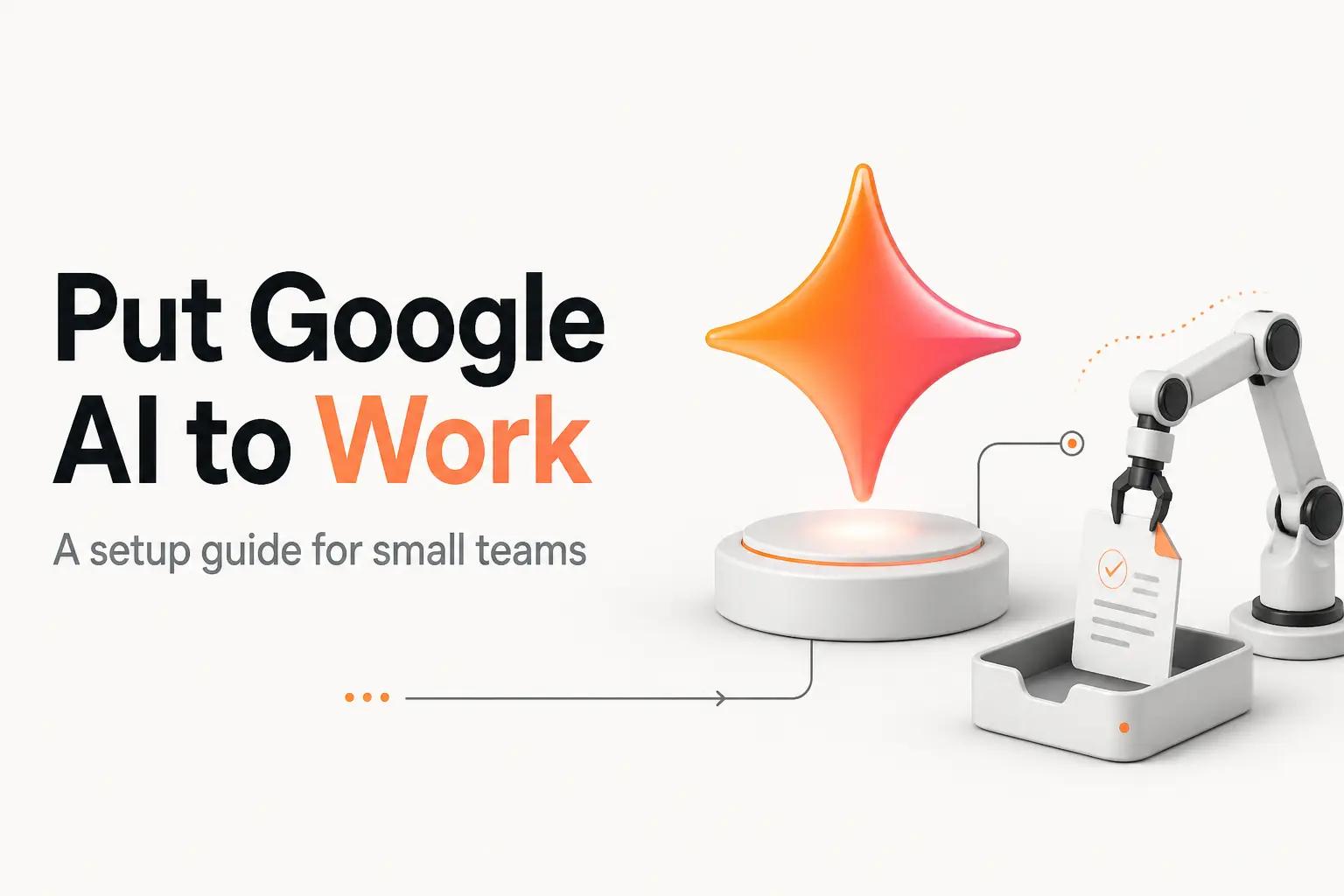
There is a little sparkle icon in the corner of your Gmail. Most owners of a growing business have clicked it once, watched Gemini draft an email, thought "neat," and never opened it again. Meanwhile the actual busywork keeps happening by hand: re-keying a lead from a contact form into the CRM, pulling numbers out of supplier PDFs, summarizing the same weekly report, answering the same five customer questions.
Google put AI inside the tools a small team already uses every day. That is the opportunity and the trap. The opportunity is that you are probably paying for capable models right now and using almost none of it. The trap is that "chat with Gemini in a tab" is not automation, and treating it like one keeps you stuck copy-pasting.
Closing that gap is less about buying anything new and more about knowing which Google tool you are actually reaching for, because a chat tab and a background workflow are not the same thing wearing different names. Prices and limits below are from Google's own pages, checked in 2026.
What "Google AI" actually means for a small business
"Google AI" is not one product. For a small team it comes in four shapes, and knowing which one you are touching decides whether you get a toy or a system.
- Gemini inside Google Workspace. The AI woven into Gmail, Docs, Sheets, Slides, Meet, and Drive. Help me write, the Gemini side panel, meeting notes, and Gems all live here. Google now includes these features in its business editions rather than charging for a separate add-on, per Google's Workspace admin documentation.
- The Gemini app. The standalone chat assistant at gemini.google.com. Good for one-off drafting and research. It does not touch your other tools on its own.
- NotebookLM. A research assistant you feed with your own sources, so answers stay grounded in your documents instead of the open web.
- The Gemini API. The raw models your developer, or your automation partner, calls from code. This is the only one that runs work in the background across your stack. Everything upstream is a person typing into a box.
The first three help a human work faster. The fourth is where the copy-paste actually stops. Most small businesses live entirely in the first three and wonder why the manual work never goes away.
Step 1: Switch on the Gemini features you already pay for
If you are on Google Workspace Business Standard or Business Plus, the Gemini features are bundled into the plan. Business Standard runs $14 per user per month and Business Plus $22 per user per month on annual billing, per Google's business editions page. You are likely paying for AI you have not turned on.
In the Google Admin console, an admin controls Gemini access per service. Confirm the side panel is enabled across Gmail, Docs, Sheets, Slides, and Drive so your team actually sees it. Then get specific about where it earns its keep:
- Gmail: summarize a long thread before a call, draft a reply from a one-line prompt, and search across your inbox in plain language.
- Docs: turn rough notes into a first draft, rewrite a section for tone, and generate a summary at the top of a long doc.
- Sheets: ask the side panel to build a formula, clean a column, or explain what a tab is doing.
- Meet: automatic notes and action items so nobody plays scribe.
Set one rule with your team this week: before anyone writes a routine internal doc or a status summary from scratch, they draft it with the side panel first and edit down. That single habit is where the included features pay for themselves. It will not remove a workflow, but it removes friction from the writing tax every team pays.
Step 2: Build Gems for the tasks you repeat every week
A Gem is a saved, reusable Gemini assistant with its own instructions. Google rolled Gems into the side panel of Workspace apps, so you can build one once and call it from Docs, Sheets, Drive, or Gmail. This is the first real step up from generic chat, because you stop re-explaining the same context every time.
Think about the prompts your team types over and over, then freeze them into Gems:
- A support-reply Gem loaded with your tone, refund policy, and top answers, so first drafts of customer replies come out on-brand.
- A proposal Gem that knows your services, your pricing bands, and the structure you always use.
- A meeting-to-tasks Gem that turns a messy call transcript into a clean action list in your format.
A Gem still needs a person to run it and paste the result somewhere. That is fine for judgment-heavy writing where you want a human reading every line. It is the wrong tool for volume. If the same Gem gets run 40 times a day against inbound emails, you have found a workflow that should run itself, which is Step 4.
Step 3: Point NotebookLM at your real documents
Generic chat answers from whatever the model absorbed on the open internet. For a small business the useful questions are about your reality: what does our contract say about late payment, what did we agree with this vendor, what is the actual step-by-step for onboarding a client. NotebookLM answers only from sources you upload, and it cites back to the source, so you can trust the answer enough to act on it.
Practical uses that land quickly:
- Drop your SOPs, contracts, and policy docs in and let the team ask questions in plain language instead of scrolling a 40-page PDF.
- Load a stack of customer-research notes or call transcripts and ask for the patterns across them.
- Turn a dense internal doc into an audio overview for people who would rather listen on a commute.
NotebookLM is grounded and honest, which makes it genuinely useful for a team that cannot afford a wrong answer pulled from nowhere. Its limit is the same as the others: it is a place a person goes to ask. It does not watch your inbox or update your CRM. It is the smartest research tool in the building, not a worker.
Step 4: Wire Gemini into your workflows with the API
Everything above still has a human in the loop, typing prompts and moving results by hand. The Gemini API is where that changes. Instead of a person opening a tab, your systems call the model automatically when a trigger fires, and the output lands where it needs to go.
Concrete shapes this takes for a small business:
- A contact form submits, the API classifies and enriches the lead, and it lands in HubSpot or Pipedrive already tagged, with no human retyping anything.
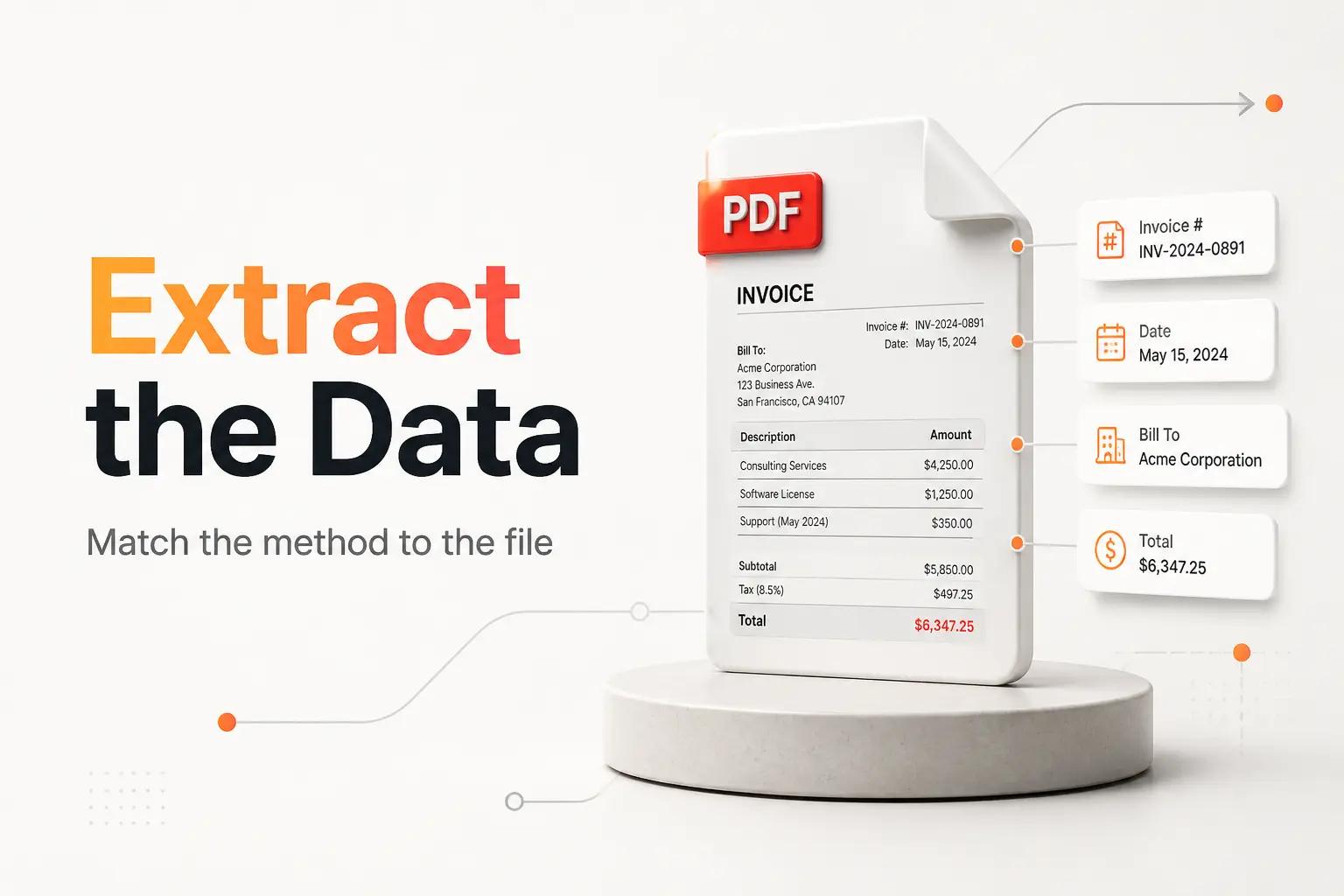
- A supplier invoice hits a shared inbox, the model extracts the line items and totals, and a clean row appears in your accounting sheet or your ledger.
- A support email arrives, the model drafts a grounded reply from your policies and routes anything ambiguous to a person instead of guessing.
The models are capable enough for this. Gemini 2.5 Flash accepts an input context window of 1,048,576 tokens, roughly a million, per Google's model documentation, which is plenty to hand it a long document plus your instructions in one call. On price, the paid Gemini API tier lists $1.50 per 1 million input tokens and $9.00 per 1 million output tokens on Google's API pricing page. For grounding answers in live Google Search, Google includes 5,000 grounding requests per month before charging $14 per 1,000 after that, on the same page. For most small-business volumes, the model cost of a workflow like the ones above is measured in dollars a month, not hundreds.
The catch is that the API is the one piece a non-developer cannot switch on from a settings menu. It needs someone to build the trigger, the extraction logic, the error handling, and the connection into your CRM, sheet, or ledger. That build is exactly the gap between "we use Gemini sometimes" and "the work runs without us."
Common mistakes that keep Google AI as a toy
The teams that get nothing out of Google's AI usually make the same avoidable errors.
- Mistaking the tab for the automation. Chatting with Gemini feels productive, but if a person still moves every result by hand, you saved a little typing and automated nothing. The repetitive, high-volume work needs the API, not the side panel.
- No grounding. A model asked to answer about your business from general knowledge will invent a plausible wrong answer. Feed it your real documents through NotebookLM or through retrieval in an API workflow, or do not trust the output.
- Pasting sensitive data into a consumer account. Personal Gemini accounts are not the same as your Workspace or API setup on data handling. Keep customer records and contracts inside the business tooling with the right controls, not a personal chat window.
- Building a brittle one-off nobody owns. A script one person wired up over a weekend, with no error handling and no monitoring, breaks silently the first time an input looks unusual. It worked at 50 records and dies at 5,000, and the person who built it has moved on.
That last one is the quiet killer. The AI part is rarely the hard part now. The reliability, the edge cases, and the monitoring are.
When to do it yourself vs bring in bottta
Steps 1 through 3 you should do yourself this week. Turn on the side panel, build a few Gems, load NotebookLM with your docs. That is a settings-and-habits job, and no one should charge you for it.
Step 4 is where working with bottta pays for itself, and it is where we recommend starting when the goal is to actually remove a workflow rather than speed up a person. bottta is an automation studio. We design and build the AI Automation and Integrations that turn Gemini from a tab you visit into a process that runs on its own: the LLM routing and extraction, the connection into your CRM, Stripe, Slack, or accounting stack, the error handling, and the monitoring that tells you when something needs a look. We map the workflow first, then build the thing that runs it, so it survives volume and staff turnover instead of living on one person's laptop.
Two ways to work with us. The $4K project fits when you have one clear workflow to remove, like invoice extraction into your ledger or lead enrichment into your CRM, and picking which one to start with is its own decision we cover in the first processes worth automating. It is fixed scope, fixed price, integrations included, with 30 days of post-launch support. The $3K per month retainer fits when you have a backlog: flexible hours, up to three active workflows at a time, and ongoing monitoring and fixes as your tools change. Both are built to be owned by us and handed to you working, not dumped as a half-finished script.
You can wire this up in-house if you have an engineer with spare cycles, and plenty of teams start with a DIY tool like Zapier or Make bridging Google AI to their apps. That is a fair place to prototype. The reason teams call us is the second mile: the grounding, the edge cases, and the monitoring that decide whether an automation you trust with real customer data holds up. To scope your first one, start a project or book a call with bottta.
Frequently asked questions
Is Google AI free for small businesses?
Partly. The Gemini app has a free tier, and NotebookLM is free to start. The Gemini features inside Google Workspace come with Business Standard at $14 per user per month and Business Plus at $22 per user per month on annual billing, per Google's business editions page, so they are included rather than separately free. The Gemini API has a free tier plus paid usage-based pricing for anything running in production.
Do I need a developer to use Google AI?
Not for the Workspace side panel, Gems, or NotebookLM. Those are point-and-click. You need a developer, or an automation studio like bottta, only for Step 4: calling the Gemini API to run work automatically across your CRM, inbox, and other tools without a person in the loop.
Is Google Gemini better than ChatGPT or Claude for a small business?
For a team already living in Gmail, Docs, and Sheets, Gemini's built-in integration is the practical edge, because the AI is where the work already happens. On raw model quality the three are close and change monthly. What matters more than the model is how it is wired into your workflow. See our take on ChatGPT for business for the comparison.
What can I actually automate with the Gemini API?
The high-volume, rules-plus-judgment tasks a person does over and over: classifying and routing inbound leads or tickets, extracting fields from invoices and PDFs, drafting grounded replies, and summarizing documents into a system of record. See AI automation for small business and how to automate data entry for the workflows that fit best.
How much does it cost to run a Gemini workflow?
The model itself is cheap at small-business volume. Google's API lists $1.50 per 1 million input tokens and $9.00 per 1 million output tokens on its pricing page, so a workflow processing a few thousand documents a month typically costs single-digit to low-double-digit dollars in model usage. The real cost is the one-time build and the ongoing reliability, which is what a project or retainer covers.