Multi-System Reconciliation: What to Look For
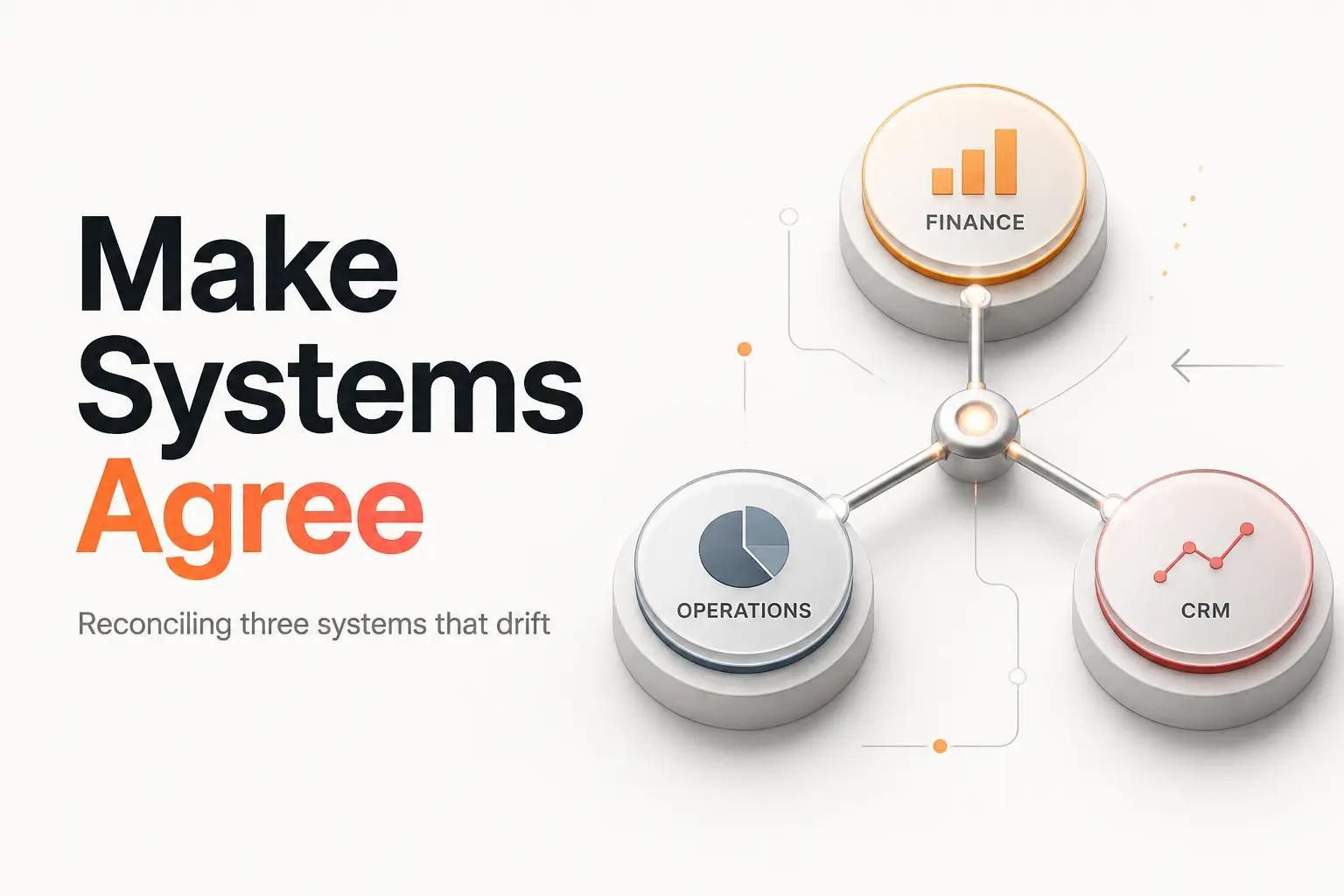
A deal closes in HubSpot for $9,000. Stripe collects it as eleven monthly charges, minus fees, minus one refunded add-on. QuickBooks Online books the revenue on a different date than either. At month-end, three systems each hold a number that is supposed to describe the same customer, and no two of them agree. Someone opens three tabs and starts matching by hand.
Reconciling two systems is annoying. Reconciling three or more is a different problem, because the mismatches multiply and the question is no longer "which one is right" but "which one is right about this specific field." A CRM should own the pipeline. A billing system should own what was charged. The ledger should own the books. The reconciliation is the layer that decides, per field, who wins, and flags it when they disagree.
This is an evaluation post, not a tool roundup. What separates a reconciliation that holds from one that becomes a second manual job is a handful of specific capabilities, plus knowing which ones you actually need at your size and which you can safely ignore. If you want a ranked list of named products, the sibling posts on data reconciliation tools and account reconciliation software cover those.
Why three systems drift when two barely stayed in sync
Most drift is not one big failure. It is a dozen small, structural reasons the same event lands differently in each system.
Delivery is not exact-once. Systems talk to each other over webhooks and API calls, and those are built to retry. Stripe's own documentation says a webhook endpoint "might occasionally receive the same event more than once" and tells you to guard against duplicates by logging the event IDs you have already processed. Stripe retries failed deliveries for up to three days, and it does not guarantee events arrive in the order they happened. So a naive sync can create a duplicate invoice, or apply a refund before the charge it belongs to.
Idempotency has a shelf life. The standard defense against double-processing is an idempotency key, a unique token that lets a system recognize a retried request. Stripe stores the result of the first request against that key, but its API reference notes keys can be pruned after they are at least 24 hours old, after which a reused key generates a fresh request. A retry a week later is a brand-new write. If your reconciliation assumes a shared ID is forever unique, that assumption breaks quietly.
The same event has different birthdays. A CRM records revenue when the deal closes. Billing records it when the invoice is issued. Accounting recognizes it when it is paid or on the invoice date, depending on whether you are on a cash or accrual basis. None of these are wrong. They are just three different clocks, which is why month-end never nets to zero on the first pass, the same reason QuickBooks never quite matches your bank statement until you account for timing.
Add currency rounding, timezone offsets, and one person editing a deal amount after it already synced, and you have a system that needs an explicit reconciliation layer, not hope.
The capabilities that earn their keep
When you evaluate a reconciliation setup, whether you build it or buy it, these are the things that separate a workflow that holds from one that becomes a second manual job.
One source of truth per field, not per system
The single biggest design decision is assigning ownership at the field level, not the system level. The CRM owns pipeline stage and owner. Billing owns what was actually charged, in what currency, with what fees. The ledger owns recognized revenue and the closed books. When two systems disagree about a field, the owner wins and the other gets corrected or flagged. Without this rule, every mismatch is a debate. With it, most mismatches have an obvious answer and the workflow can resolve them without a human.
Exact-key matching before anything fuzzy
The first pass should match on shared identifiers that both systems carry: an invoice number, a Stripe charge ID, a customer ID, a purchase order. Exact-key matching is fast, unambiguous, and clears the large majority of records. Only what is left over goes to harder logic. A setup that jumps straight to fuzzy matching on names and amounts produces false matches you then have to unwind, which is worse than the original problem.
Composite matching for records with no shared ID
Some records genuinely have no common key. A bank deposit does not carry your invoice number. Here the workflow needs composite matching: amount plus date plus counterparty, within a tolerance. Fuzzy name matching comes last, only after exact and composite passes are exhausted, and it should always surface its confidence rather than silently deciding. This is the same discipline behind reconciling a payment processor payout to your ledger, where one deposit has to be broken back into charges, fees, and refunds before anything ties.
Idempotency and stable keys so retries do not double-count
Because delivery retries and reused keys are normal, the reconciliation has to be idempotent: processing the same event twice must produce the same result as processing it once. In practice that means storing the external event or transaction ID and refusing to act on one you have already recorded. This is the exact guard Stripe recommends, and it is the difference between a sync that self-heals after a hiccup and one that quietly books a payment twice.
Timing and basis normalization
The workflow has to know that the CRM's close date, the invoice date, and the recognition date are different by design, and compare like with like. That means normalizing to one basis before matching, handling timezone and currency conversion explicitly, and treating a timing gap as expected rather than an error to chase. A reconciliation that flags every accrual-versus-cash difference as a discrepancy trains everyone to ignore its alerts.
Exception logging instead of forcing everything to match
The goal is not to make every record in every system identical. It is to catch the ones that matter. A good setup reconciles quietly in the background and only surfaces the exceptions: the deposit that does not tie, the invoice with no matching charge, the amount off by more than a set tolerance. Each exception carries its likely cause so a person can act in seconds instead of investigating from scratch. You review a short list of real problems, not a full ledger.
Monitoring and alerting on the sync itself
The failure mode that hurts most is the silent one, where a sync stops and nobody notices for three weeks. The reconciliation layer should watch its own plumbing: alert when a scheduled run fails, when exception volume spikes, when a system stops sending events at all. This is the same monitoring gap that turns a working QuickBooks and Stripe integration or Stripe and Xero integration into a month of untangling. A workflow nobody is watching is a workflow that is already broken and you do not know it yet.
Features you can skip for now
Reconciliation vendors sell a lot of capability aimed at finance teams far larger than yours. For a team of 1 to 50, most of it is cost and configuration you will not use.
- A dedicated data warehouse or lake to stage everything before matching. For a handful of systems, matching directly against each system's API is simpler and cheaper. You do not need a pipeline team.
- Machine-learning anomaly detection. Threshold-based exception rules catch the discrepancies that actually cost you money. ML flagging earns its keep at transaction volumes most lean teams are years from.
- Real-time streaming reconciliation. Daily or even hourly batch checks on the fields that must tie out are plenty. Continuous reconciliation adds engineering cost for a freshness you do not need to close the month.
- A full month-end close platform with workpapers, sign-offs, and audit trails. If you are a growing team rather than a finance department, that is a heavier tool than the problem, as the account reconciliation software roundup gets into.
Skip these until the volume genuinely demands them. Adding them early buys complexity, not accuracy.
How bottta handles this
DIY connectors get you the easy 80%. A Zapier or Make scenario can move a record from one system to another, and for a simple two-step handoff that is the right call. What they do not do is reconcile. They fire on an event and forget it, with no source-of-truth logic, no exception log, and no monitoring when they silently stop. The moment you have three systems and money on the line, the gap between "data moved" and "data agrees" is exactly the part they leave to you.
That gap is what bottta builds. This is Integrations and Workflow Design work first: we map every field across your CRM, billing system, and ledger, decide who owns what, and wire the matching so exact keys clear first and only genuine exceptions reach a person. Where records need judgment, an AI extraction layer reads the messy inputs behind a confidence gate, so a human confirms the ambiguous ones instead of all of them. Then we add the monitoring that tells you the day a sync breaks, not the week you find out at close.
Two ways to work together. A $4K fixed-scope project fits a defined reconciliation between named systems: fixed price, integrations included, 30 days of post-launch support. The $3K per month retainer fits an operation with several workflows that keep evolving, with up to three active at a time, ongoing monitoring, and fixes as your stack changes. No free tier and no self-serve button, because reconciliation logic is specific to your systems and there is nothing generic to sign up for. If you would rather see the deeper build steps first, the reconcile-payments guide walks through one end to end.
Frequently asked questions
What is multi-system reconciliation?
It is the process of making three or more systems that each store a version of the same business event, such as a CRM, a billing system, and accounting software, agree on the fields that have to tie out. Unlike a simple bank reconciliation, it assigns each field to an owning system and flags only the mismatches that matter.
How is it different from reconciling in QuickBooks?
A QuickBooks reconciliation checks one account against one statement. Multi-system reconciliation checks the same record across several tools at once, so it has to handle different identifiers, different timing, and no single shared key, which a single-account reconciliation never faces.
Can Zapier or Make reconcile my systems?
They can move data and, with careful design, dedupe some of it. They do not natively reconcile: there is no source-of-truth resolution, exception log, or self-monitoring. For a two-step handoff they are fine. For three systems that must agree on money, you want a built workflow with those pieces designed in.
How often should reconciliation run?
Run a lightweight check daily or weekly on the high-impact fields, invoice total, payment status, amounts, then a deeper review of balances and aged items monthly. Continuous real-time reconciliation is rarely worth the cost for a lean team.
Do I need a data warehouse to reconcile across systems?
Not for a handful of systems. Matching directly against each system's API is simpler and cheaper at that scale. A warehouse earns its place when you have many sources and high volume, not before.
Reconciliation is a design problem before it is a tooling problem. Decide who owns each field, match exact keys first, log the exceptions, and watch the plumbing. If you want that built and monitored rather than assembled from connectors and hope, start a project with bottta.