Agentic AI vs AI Agent: The Difference That Matters
Two decks land on your desk the same week. One vendor is selling an "AI agent" that triages support tickets. The other is pitching an "agentic AI platform" for the same job, at four times the price. You run ops, not a research lab, and now you have to work out whether these are two different products or the same idea wearing different marketing, and whether the expensive one does something the cheap one can't.
The two terms are related, not interchangeable, and the gap between them is real once you know where to look. Here is what each word means in the language the major vendors actually use, and what the distinction should change about the check you sign.
Quick verdict
An AI agent is the building block: one language model running in a loop, using tools to chase a goal. Agentic AI is the property of a whole system that strings agents and steps together to work with autonomy across a longer horizon. Neither is automatically the right buy. For a team of 1 to 50 people, the honest recommendation is almost always a tightly scoped agent, or a plain workflow, designed and built by a studio like bottta, not a sprawling "agentic" platform you cannot debug. The label on the deck matters far less than how much autonomy you are paying for.
AI agent and agentic AI at a glance
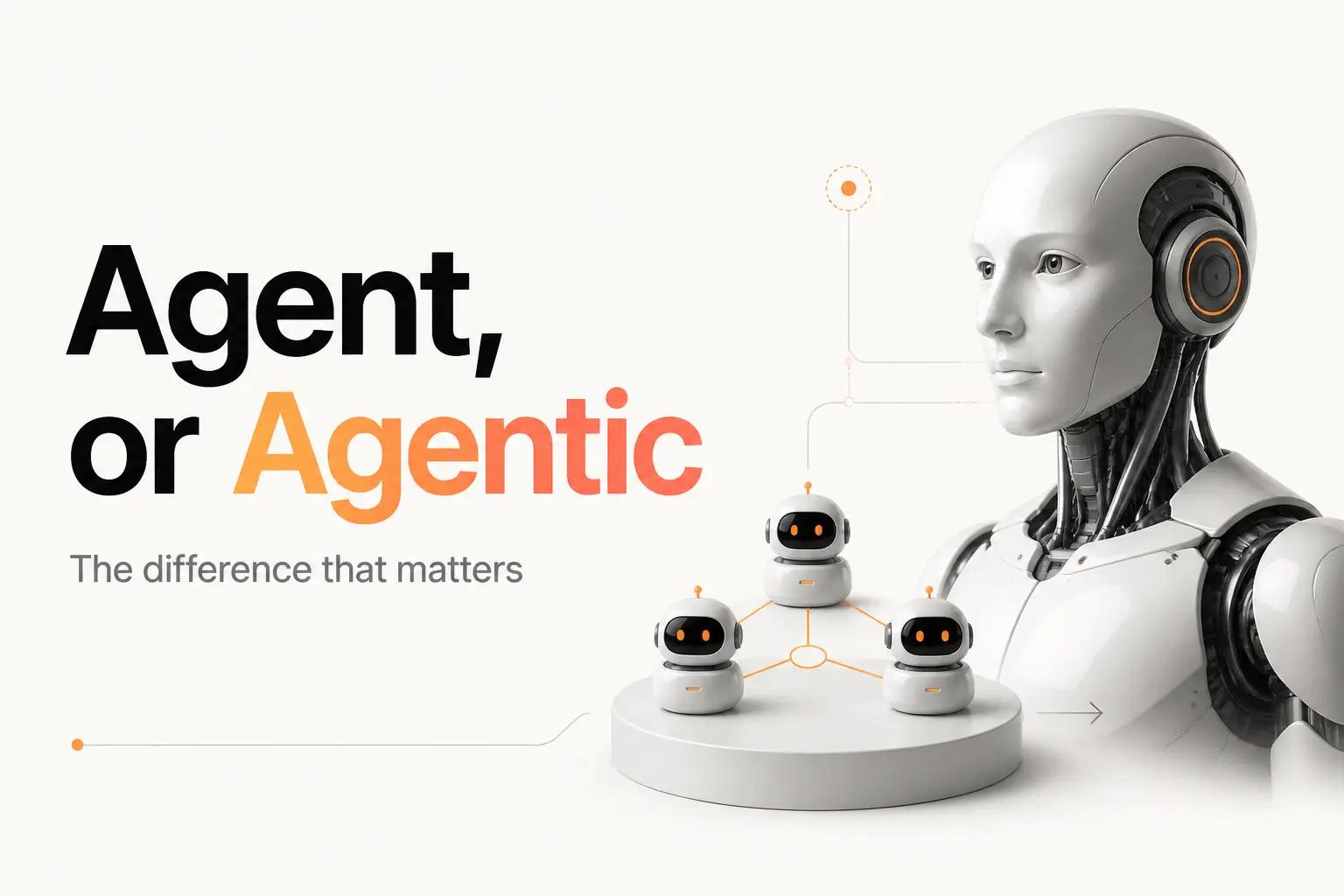
The clean way to hold the two apart: an agent is a part, agentic AI is a property of the whole when those parts are wired to pursue goals on their own.
| AI agent | Agentic AI | |
|---|---|---|
| What it is | One model in a loop with tools and memory | A system that coordinates agents and steps toward a goal |
| Scope | A specific task or task family | A longer, multi-step objective |
| Autonomy | Decides its next tool call | Self-directs across the whole process, often with less supervision |
| Moving parts | One control loop | An orchestrator, multiple agents, shared state |
| Buying signal | "It reads the ticket and acts" | "It runs the department" |
The rows on the right cost more to build, cost more to run, and fail in more places. That is the trade the pricing on those two decks reflects.
What an AI agent actually is
Strip the marketing and an AI agent is a narrow thing. Anthropic's engineering team settled on a definition worth memorizing: an agent is a language model "autonomously using tools in a loop." The model looks at the current state, decides on a tool call, reads the result, and decides whether it is done or needs to go again. IBM describes the same unit as a software program that acts autonomously to understand, plan, and execute a task.
The loop is the whole story. A customer-service chatbot answers a prompt and stops. An agent is given a goal and keeps acting until it judges the goal met. OpenAI frames this as the shift from single chat interactions to delegated, long-horizon tasks, work you hand off rather than prompt line by line.
A concrete one: an agent for refund triage reads a messy ticket, looks up the order, checks it against your policy, decides between a refund and a replacement, calls Stripe, and posts a note in Slack. One loop, a handful of tools, no human approving each move. That is a single agent, and for most lean-team problems it is as far up the autonomy ladder as you ever need to climb. We go deeper on the mechanics in what agentic AI actually means.
What "agentic AI" adds on top
Agentic AI is the word vendors reach for when there is more than one agent, or one agent with a lot of rope. IBM puts the hierarchy plainly: agentic AI is the framework, and AI agents are the building blocks within it. The system understands a goal, breaks it into pieces, and pursues them with limited supervision.
The extra machinery is orchestration. In a multi-agent setup, a control layer decides which specialized agent runs when, how work hands off between them, and how shared state stays coherent. NVIDIA's glossary describes these systems as stateful, multi-step agent graphs, with agents that can even spawn sub-agents and decide for themselves when they are finished. A research agent that plans a query, dispatches sub-agents to gather sources, and synthesizes the result is agentic. A single agent that files a refund is not, even though both use a model in a loop.
That is the honest difference. Not a hard line, a spectrum. The more steps you let the system decide unsupervised, and the more agents you let it coordinate, the further into "agentic" territory you are, and the more it will cost you in every sense.
Why the distinction changes what you buy
Here is where the terminology stops being pedantic. When a vendor upgrades the word from "agent" to "agentic," they are usually selling more autonomy and more moving parts. Both are liabilities for a small team, not features.
- More autonomy means more ways to act wrong. A chatbot's bad answer is a bad answer. An agent's bad action already refunded the wrong customer. Multiply the autonomous steps and you multiply the blast radius.
- More agents mean nondeterministic behavior you have to debug. The same ticket can take two different paths through an orchestrated system. That is harder to trace than any brittle Zap you have owned.
- The token bill scales with the loop. Every step re-sends context to the model, so a chatty multi-agent system burns money a fixed workflow never would.
The adoption numbers say buyers are learning this the hard way. In McKinsey's State of AI in 2025, 62% of respondents said their organizations are at least experimenting with AI agents, but only 23% reported scaling an agentic system in even one business function. Gartner predicts that more than 40% of agentic AI projects will be canceled by the end of 2027, citing escalating costs, unclear value, and inadequate risk controls. More agents did not turn out to mean more results.
What a lean team actually needs
Start from the work, not the word. Nearly everyone searching "agentic AI vs AI agent" has one concrete, repetitive process they want to stop doing by hand: the refund triage, the lead-to-CRM handoff, the invoice that gets re-keyed every month. That rarely calls for a fleet of coordinated agents. It calls for a reliable workflow with a thin layer of judgment where a step genuinely needs it.
That is the work bottta does. We are an automation studio that designs and builds the workflow, then keeps it running. Our default is deterministic and API-first, because a defined path does not improvise with your billing. We use a single agent only for the step that truly needs it, reading a messy ticket, extracting fields from a PDF, routing an email, and wrap the whole thing in monitoring so a failure pages us instead of surfacing three days later. That maps to four services: Workflow Design (mapping the process and the clean handoffs), Integrations (the APIs and webhooks between your tools), AI Automation (extraction, routing, and the narrow agent steps where they belong), and Custom Builds (the internal tools and dashboards behind it).
Two ways to work with us. The $4K project is fixed scope and fixed price, integrations included, with 30 days of post-launch support, right for one well-defined process like the refund flow above. The $3K/month retainer gives you flexible hours, up to 3 active workflows at a time, and ongoing monitoring and fixes, right when the work keeps coming and you want someone owning it.
If the process is simple and low-stakes, building it yourself is a fair call. Zapier, Make, and n8n all ship agent features now and are a reasonable place to prototype a single agent. Before you commit either way, run the task through our test for when to automate and when not to, and see where the model actually earns its keep in AI automation for a small business. The right question was never "agent or agentic." It was "how little autonomy can I get away with and still kill this busywork." Book a call and we will answer it honestly for your specific process.
Frequently asked questions
Is agentic AI just a fancier name for an AI agent?
No. An AI agent is a single unit, one model in a loop with tools. Agentic AI is a property of a system built from one or more agents, arranged to pursue a goal with autonomy across many steps. IBM frames agentic AI as the framework and AI agents as the building blocks inside it. A vendor using "agentic" is usually signaling more autonomy and more moving parts than a single agent.
Which one costs more to run?
Agentic systems, in almost every case. Each step in an agent's loop re-sends context to the model, so cost scales with the number of steps and the number of coordinated agents, not the number of tasks finished. A single narrow agent, or a deterministic workflow that calls the model rarely, is far cheaper than a multi-agent system reasoning at every turn.
Do I need a multi-agent system for my business?
Usually not. Repetitive ops work is typically a known path with a few branches, which a workflow plus one judgment step handles more cheaply and reliably than a coordinated fleet of agents. Reach for multi-agent orchestration only when a goal genuinely requires several distinct, open-ended specialties working together.
Is a chatbot an AI agent?
Not on its own. A chatbot reacts to a prompt and stops at the reply. It becomes an agent when it is given a goal and the tools to act on it, and it keeps acting until the goal is met. The difference is acting versus answering. See what agentic AI means for how the two relate to RPA as well.
How is this different from RPA?
Robotic process automation follows fixed, prewritten rules and drives your apps through their screens, so it breaks the moment a layout changes. An AI agent reasons about the situation and chooses its next step at runtime. The durable builds combine both: a model handles the judgment call, and deterministic automation carries the structured result the rest of the way.