What Is Agentic AI? A Plain Answer for Operators
A vendor emails your ops lead with a deck promising an "agentic AI" that reads every support ticket, decides what each one needs, updates the CRM, issues the refund, and only escalates the hard cases to a person. It sounds like the copy-paste that eats your afternoons finally handling itself. It also sounds like every automation pitch you have sat through, so the fair move is to pin down what the word means before anyone signs anything.
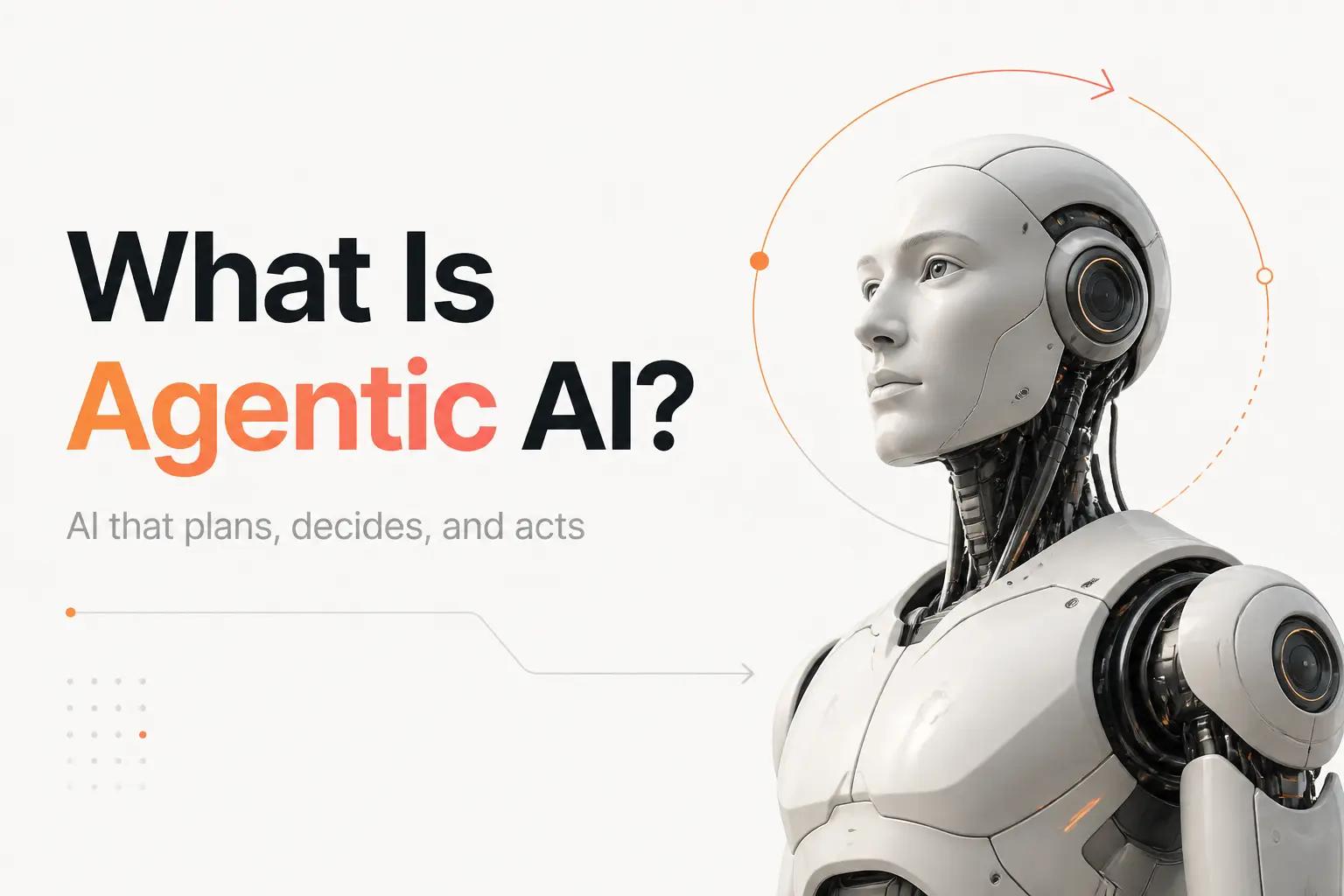
Agentic AI is software that pursues a goal on its own by planning steps, choosing and calling tools, and taking actions across your systems with limited human supervision, rather than just answering a prompt. IBM describes it as a system with autonomy, goal-driven behavior, and adaptability. Anthropic puts it more plainly in its guide to building agents: an agent is a language model using tools in a loop. That loop, deciding what to do next and then doing it, is the whole difference from the AI you already use.
Whether you actually want one is a separate question, and for most teams of 1 to 50 people the honest answer is more nuanced than the deck suggests.
What agentic AI actually means
The word that carries all the weight is "agency." A generative model answers what you ask and stops. An agent is given a goal, then runs a loop on its own: it looks at the current state, plans a next step, calls a tool to take it, reads the result, and decides whether it is done or needs to go again. It might hit a search API, write to your database, or call Stripe, all without a human approving each move.
That autonomy sits on a spectrum, and the spectrum is the useful part. Anthropic draws a line between two things people lump together. A workflow is a system where the model and its tools run along a path you defined in code. An agent is a system where the model decides the path itself at runtime. Anthropic's own recommendation is to start with a workflow and reach for a full agent only when the task genuinely needs open-ended decisions. We go deeper on that split, and when each one wins, in agentic AI vs traditional automation.
That distinction is the one operators should hold onto. Most of the busywork bleeding hours out of a lean team, moving a closed deal into Stripe, re-keying a form into the CRM, is a known path with a handful of branches. It does not need a system that reasons about what to do next. It needs a reliable one that does the same right thing every time.
Agentic AI vs chatbots vs RPA
Three things get sold under overlapping language, and they behave nothing alike once they are running in your stack. If the terms themselves are the confusing part, the automation glossary defines the ones every proposal throws around.
| What it does | How it decides | Where it stops | |
|---|---|---|---|
| Generative chatbot | Answers questions, drafts text | Reacts to each prompt | At the reply. It does not act |
| RPA | Clicks and types through app screens | Follows fixed, prewritten rules | When the script ends or a screen moves |
| Agentic AI | Plans and takes multi-step actions across tools | Chooses its own next step at runtime | When it judges the goal is met |
A customer-service chatbot drafts a reply and waits for a human to send it. Robotic process automation runs a fixed sequence of clicks and breaks the moment a button moves, because it never understood the screen, it just memorized it. An agent is the only one of the three that both reasons about the situation and acts on it. That is what makes it powerful, and it is exactly what makes it risky, because a system that can act on its own can also act wrong on its own.
What an agent looks like in a real workflow
Take the refund case from that vendor deck. A ticket lands: "ordered two, got one, want my money back." A genuine agent would read the message, look up the order in Shopify, check it against your refund policy, decide between a refund, a replacement, or an escalation, call Stripe, and post a note in the #support channel. Five tools, one loop, no human in the middle.
Here is the part the deck skips. Only one step in that chain actually needs judgment: reading a messy, human-written ticket and classifying what it is asking for. Everything after that, look up the order, apply the policy, call Stripe, post to Slack, is a known path with clear rules. The strong build is not a fully autonomous agent turned loose on your money. It is a narrow use of the model for the ambiguous read, wired into a deterministic workflow for every step that follows. Scope the agency tightly, because the more steps you let a model decide unsupervised, the more surface area you have for a confident, expensive mistake.
Where agentic AI breaks for a lean team
The gap between the demo and production is wide, and the primary research says so. Gartner predicts that more than 40% of agentic AI projects will be canceled by the end of 2027, citing escalating costs, unclear business value, and inadequate risk controls. That is a forecast, not a scoreboard, but the reasons behind it are the ones a small team feels first.
Adoption tells the same story. In McKinsey's State of AI in 2025, 62% of respondents said their organizations are at least experimenting with AI agents, but only 23% reported scaling an agentic system in even one business function. Most agent projects are stuck between a promising pilot and something you can actually trust in production.
For a team of 1 to 50 people, three costs do the damage. An agent that acts is an agent that can act wrong, and unlike a chatbot's bad answer, a wrong action already refunded the wrong customer. The behavior is nondeterministic, so the same ticket can take two different paths, which makes debugging harder than any Zap you have owned. The token bill scales with the loop, because every step re-sends context to the model, and a chatty agent burns money a fixed workflow never would. The API key is the easy part. The design, guardrails, and monitoring are the half that decides whether it saves time or quietly causes an incident.
Do you actually need an agent?
Usually not the fully autonomous kind, and that is the honest answer, not a hedge. Most lean teams searching for "agentic AI" have a concrete, repetitive process they want to stop doing by hand. That is a job for a reliable workflow with a thin layer of AI where a step needs judgment, not for a system you turn loose on your tools and hope.
That is the work bottta does. We are an automation studio that designs and builds the workflow, then keeps it running. Our default is deterministic and API-first, because automation that follows a defined path does not improvise with your billing. We bring in the model only where a step genuinely needs it, reading a messy ticket, extracting fields from a PDF, routing an email, and wrap the whole thing in monitoring so a failure pages us instead of surfacing three days later. That maps to four services: Workflow Design (mapping the process and the clean handoffs), Integrations (the APIs and webhooks between your tools), AI Automation (extraction, routing, and the narrow agent steps where they belong), and Custom Builds (the internal tools and dashboards behind it).
There are two ways to work with us. The $4K project is fixed scope and fixed price with integrations included and 30 days of post-launch support, right for one well-defined process like that refund-triage flow. The $3K/month retainer gives you flexible hours, up to 3 active workflows at a time, and ongoing monitoring and fixes, right when the work keeps coming and you want someone owning it.
If you would rather build it yourself, that is a real option for a simple, low-stakes flow. Zapier, Make, and n8n all ship agent features now and are a reasonable place to prototype. Before you commit, run the task through our test for when to automate and when not to, and read our take on AI automation for a small business for where the model actually pays off. If you would rather have the workflow designed, built, and watched than babysit another platform, that is what working with bottta gets you, an agent only where the job truly needs one and a plain workflow everywhere else.
Frequently asked questions
Is agentic AI the same as a chatbot?
No. A chatbot answers a prompt and stops. An agent is given a goal and takes action to reach it, calling tools and moving through steps on its own. A chatbot can draft a refund email. An agent can look up the order, decide, and issue the refund. The ability to act, not just respond, is the line between them.
Is agentic AI the same as RPA?
No. Robotic process automation follows fixed, prewritten rules and drives your apps through their screens, so it breaks when a layout changes. Agentic AI reasons about the situation and chooses its next step at runtime. In practice the durable builds combine both: a model handles the judgment call, and deterministic automation moves the structured result the rest of the way.
Do I need agentic AI for my business?
Probably not in its fully autonomous form. Most repetitive ops work is a known path with a few branches, which a reliable workflow handles better and more cheaply than an agent that reasons every time. Use the model for the one or two steps that genuinely need judgment, and keep everything else deterministic.
Is it safe to let an agent act on its own?
Only with guardrails. An agent that can issue refunds can also issue the wrong one, so the safe pattern is to scope its authority narrowly, put a human approval on high-stakes actions, and monitor every run. Gartner's forecast that more than 40% of agentic projects may be canceled by 2027 traces partly to teams skipping exactly these controls.
Why do agentic AI projects cost more than expected?
An agent re-sends context to the model on every step of its loop, so cost scales with how many steps it takes, not how many tasks it finishes. A fixed workflow calls the model rarely or never. Gartner names escalating costs as a leading reason agentic projects get canceled, which makes scoping the agency tightly a budget decision as much as a design one.