Robotic Process Automation in Real Estate: A Build Guide
A commercial lease lands in the property manager's inbox as a 40-page PDF. Someone opens it, hunts for the base rent, the escalation schedule, the renewal window, and the CAM pass-throughs, and types every field into Yardi by hand. RSM US puts manual lease abstraction at 3 to 4 hours per real estate lease, and 1 to 2 hours per equipment lease. Run that across a portfolio of a few hundred leases and the abstraction backlog quietly becomes a full role nobody budgeted for.
Robotic process automation is the software that does that keying for you. A bot logs into your systems, reads the fields, and moves the data on a schedule or a trigger. The same shape repeats everywhere in a real estate operation: AP invoices from vendors, tenant applications, rent reconciliations, renewal notices going out on time.
One thing to settle up front, because it decides everything downstream. Most real estate automation is not really a clicking problem. It is a reading problem wearing an RPA costume. Get that distinction wrong and you build a bot that breaks the first time a lease PDF is laid out differently than the last one.
Step 1: Pick the one workflow bleeding the most hours
Do not try to automate the whole back office at once. Rank the candidates by volume times manual minutes, and start with the single highest number, the same way you would pick any first process to automate. In most real estate operations the shortlist looks like this:
- Lease abstraction. Pulling terms out of lease PDFs into a lease admin or accounting system. High volume, high hours, and directly on the clock for ASC 842 lease accounting compliance.
- AP invoice processing. Vendor invoices arriving by email, matched to a property and a work order, then posted into Yardi, AppFolio, or Buildium.
- Tenant onboarding and screening. Application data, ID and income documents, background and credit checks, then a clean record created across the CRM and property-management system.
- Rent reconciliation and renewals. Matching payments to ledgers, flagging exceptions, and firing renewal or notice reminders inside the legal window.
Pick the one where the hours are real and the rules are stable. Lease abstraction and AP invoices usually win because they are high volume and mostly rule-based. A workflow that changes shape every week is a bad first target. Automate the boring, repetitive one first, prove it, then move to the next.
Step 2: Map the trigger, the systems, and every field the bot touches
Before any tool gets opened, write the workflow down end to end. A bot can only be as reliable as the map behind it.
Start with the trigger. Is it a new email in an AP inbox, a form submission from a tenant portal, a file dropped in a shared drive, or a nightly schedule that sweeps for new records. Then list every system the data passes through and, more importantly, which one is the source of truth. If both your CRM and Yardi hold a tenant record, decide now which one wins when they disagree.
Then list every field, by name, with its type and its destination. For a lease that is base rent, term start and end, escalation rate, renewal option, notice period, and CAM treatment. For an invoice it is vendor, invoice number, amount, property, GL code, and due date. This field list is the contract for the whole build, and it is the same data-readiness check any automation starts with. It is where the edge cases surface early: a tenant name with a comma that breaks a CSV, a scanned lease that is an image rather than selectable text, an invoice with two line items that should split across two properties.
Step 3: Split the rule-based steps from the document-reading steps
This is the step most naive real estate builds skip, and it is why they fail.
Classic RPA drives the user interface. It logs in, clicks, types, and reads text off a predictable screen. That works beautifully for the deterministic half of the job: moving a known value from field A in one system to field B in another. It falls apart the moment the input is a document, because a lease from one landlord looks nothing like a lease from another, and a scanned invoice has no fields at all, just pixels.
So split the workflow in two:
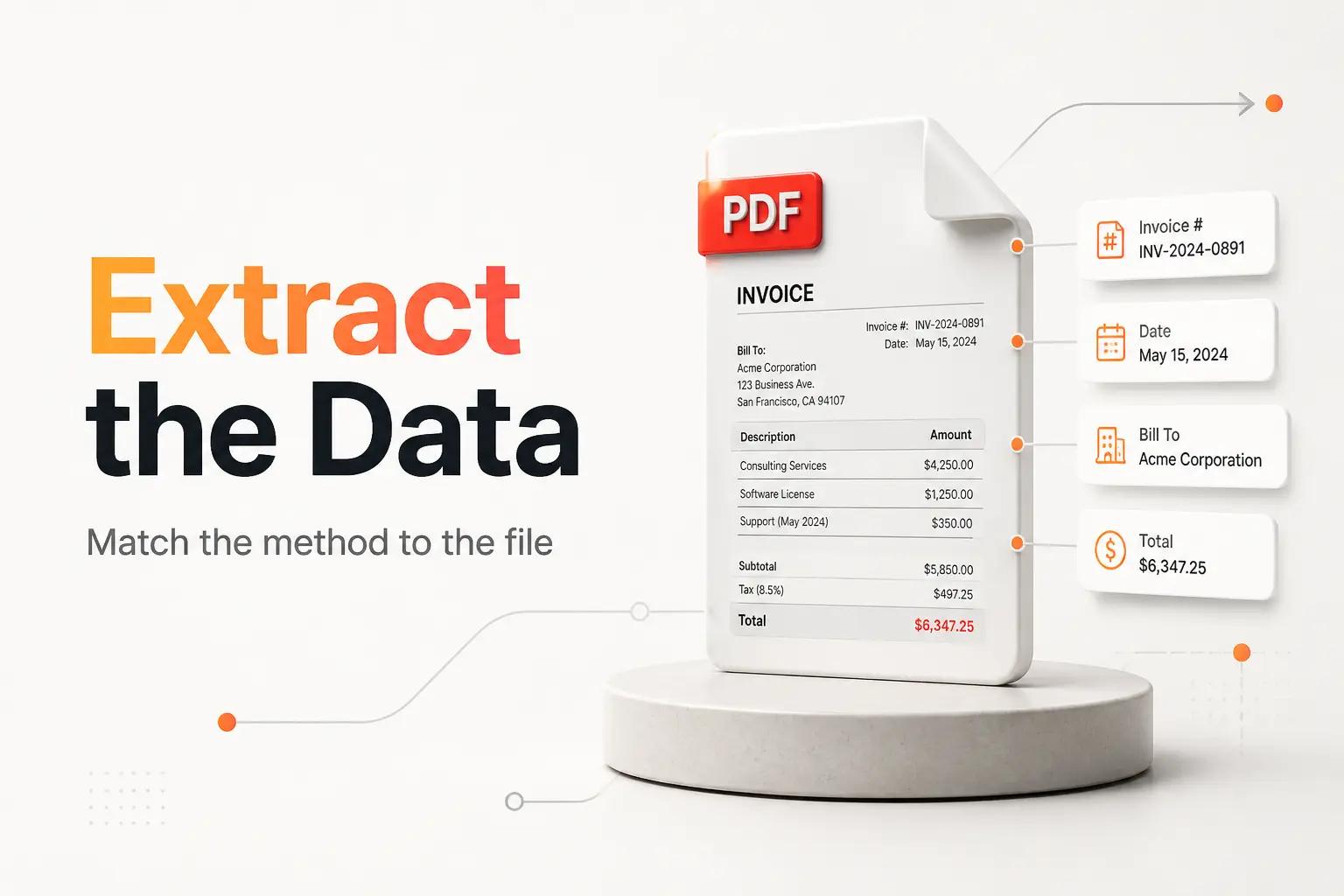
- The reading layer turns an unstructured document into structured fields. This is intelligent document processing or an LLM extraction step, not screen-scraping. Tools built for this include UiPath Document Understanding and a growing set of LLM-based extractors. This layer needs a confidence score on every field and a review queue for anything below threshold.
- The moving layer takes those clean fields and puts them where they belong, through the property-management system's API where one exists, or through the UI where it does not.
Treat the reading layer as a fast, unreliable junior clerk whose work you check, not as a source of truth. A lease abstraction that is wrong on the renewal date is worse than one done slowly by hand, because nobody re-reads a field the bot already filled. The confidence gate is what keeps that from happening. Our deeper walkthrough of the extraction pattern lives in document automation software, and the general mechanics of RPA bots are in what robotic process automation is.
Step 4: Choose the tools, and know what they cost
For the moving layer, three broad paths, roughly in order of how much of the work sits in a vendor's UI versus your own code.
| Approach | Entry price (2026, per vendor pricing) | Best for |
|---|---|---|
| Microsoft Power Automate | Premium $15/user/month, Hosted Process (RPA bot) $215/bot/month, billed yearly | Teams already in Microsoft 365 running unattended bots against legacy UIs |
| UiPath | Basic from $25/month, Standard and Enterprise are contact-sales | Document-heavy pipelines using Document Understanding at portfolio scale |
| Custom integration build | No per-bot license, developer time instead | Property-management systems with a real API, where you skip the brittle UI entirely |
Prices are from Microsoft's Power Automate pricing page and UiPath's pricing page. The enterprise tiers are quote-only, so budget a call, not a list price.
The stance worth taking: if your property-management system exposes an API, prefer the integration build over a screen-driving bot. A UI bot breaks every time AppFolio or Yardi ships a redesign and a button moves, and nobody notices until a payment posts to the wrong ledger. An API connection is boring, and boring is what you want running unattended overnight. Lighter DIY connectors like Zapier or Make can stitch two systems together for a simple two-step handoff, but they hit a wall the moment a workflow needs document reading, branching logic, or exception handling. The AP side of this build is covered end to end in invoice automation.
Step 5: Build error handling and monitoring before you scale
A real estate bot that works on 50 leases and breaks silently on 5,000 is worse than no bot, because the failure is invisible until an audit or a missed renewal surfaces it. Build the safety net before you turn up the volume.
Four things every unattended workflow needs:
- Retries with backoff for the flaky steps, so a momentary timeout logging into Yardi does not kill the whole run.
- An exception queue where any record the bot cannot handle, a low-confidence extraction or an unmatched invoice, waits for a human instead of failing or, worse, guessing.
- Alerts to where the team already looks. A message in the ops Slack channel when a run fails or the exception queue grows, not a log file nobody opens.
- A running log of what the bot did, so month-end and audit have a trail. In real estate that trail is not optional. It is what makes the automation defensible.
Then roll out in stages. Run the bot in parallel with the manual process on a small batch, reconcile the two outputs field by field, and only cut over once they match. Automating a broken or undocumented process just makes the mistakes faster.
Common mistakes that sink real estate RPA
- Screen-scraping a system that has an API. The API is more work to set up and far less work to keep alive. Pay the setup cost once.
- No confidence threshold on document extraction. Every field the reading layer fills should carry a score, and low-confidence fields go to review, not straight into the ledger.
- Automating a process nobody owns. If the workflow only lives in one person's head, document it first. A bot is a written-down process that runs itself, and you cannot automate what you cannot describe.
- No monitoring. A silent bot is not a working bot. Assume every unattended workflow will fail eventually and make sure someone hears it when it does.
- Boiling the ocean. Ten half-built automations that each break monthly are worse than one that runs clean. Ship one, stabilize it, then move on.
When to build it yourself versus bring in bottta
If the workflow is a genuinely simple two-step handoff, a form submission landing in a spreadsheet, one person can wire it in Power Automate or Zapier in an afternoon. Keep those in-house.
The moment the build needs a document-reading layer with a confidence gate, exception handling, an API integration into Yardi or AppFolio, and monitoring that actually pages someone, it stops being a weekend project. That is the work bottta does. We are an automation studio that designs and builds these workflows for you. For a real estate operation that usually means Workflow Design to map the lease or AP process cleanly, AI Automation for the extraction layer that reads the documents, Integrations to wire the property-management system through its API instead of its UI, and Custom Builds for the exception dashboard your team actually watches.
Two ways to work with us. The $4K project is fixed scope and fixed price with integrations included and 30 days of post-launch support, which fits a single defined build like lease abstraction into Yardi. The $3K/month retainer gives you flexible hours across up to 3 active workflows with ongoing monitoring and fixes, which fits a portfolio operation automating one process after another. No free tier, no self-serve button, and no bot handed over with no one owning it. If you would rather see the tool landscape first, AI tools for real estate agents covers the software side.
Frequently asked questions
Is RPA the same as AI in real estate?
No. Classic RPA follows fixed rules and drives a user interface, so it is reliable for moving known values between systems but useless on a document it has not seen before. The AI layer, intelligent document processing or LLM extraction, is what reads an unfamiliar lease or invoice and turns it into structured fields. A good real estate build uses both: AI to read, RPA or an API to move, and a human to check the low-confidence cases.
What real estate workflow should I automate first?
The one with the highest volume times manual minutes and the most stable rules. For most operations that is lease abstraction or AP invoice processing, because both are high volume, mostly rule-based, and directly tied to accounting and compliance deadlines. Skip anything that changes shape week to week until the stable workflows are running.
Do I need UiPath, or is Power Automate enough?
For a lean real estate team already in Microsoft 365, Power Automate Premium at $15 per user per month plus a Hosted Process bot at $215 per month covers most unattended workflows. UiPath earns its higher, quote-based cost mainly when you are running document-heavy pipelines at portfolio scale through its Document Understanding tooling. Match the tool to the volume, not to the brand.
Will a bot break when Yardi or AppFolio updates?
A screen-driving bot can, because it depends on buttons and fields staying where they are. That is exactly why an API integration is worth the extra setup: it talks to the system's data layer rather than its interface, so a UI redesign does not touch it. Where no API exists, build in monitoring so a break is caught in minutes, not at month-end.
How long does a real estate automation take to build?
A single well-scoped workflow, lease abstraction into one system with a review queue and monitoring, is typically a matter of weeks, not months, which is why it fits a fixed-price project. The time goes into mapping the fields, tuning the extraction confidence gate, and running the bot in parallel with the manual process until the outputs reconcile. Rushing that validation is how silent errors ship.
The lease or invoice stack you are re-keying by hand is exactly the kind of build that pays for itself the first quarter nobody loses days to abstraction. That is the one bottta builds and keeps running.